



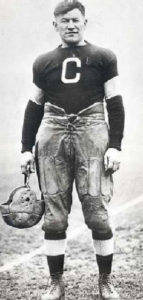
- Details
- By Library of Congress
WASHINGTON - World-class athlete Jim Thorpe was born in a one-room cabin near Prague in Indian Territory, now Oklahoma, on May 28, 1888. Thorpe’s versatile talents earned him the distinction of being chosen, in 1950, the greatest football player and the greatest American athlete of the first half of the twentieth century by American sports writers and broadcasters.

Thorpe excelled at every sport he played. The great-great-grandson of an Indian warrior and athlete, Chief Black Hawk, Thorpe’s heritage was Irish and five-eighths Indian (Sauk, Fox, and Pottowatomie). He attended Haskell Institute in Lawrence, Kansas, and the Carlisle Indian Industrial School in Pennsylvania.
Thorpe took leave of the school in 1909 to play baseball in Rocky Mount and Fayetteville, North Carolina — a fact which later cost him two Olympic gold medals. Back at Carlisle, in 1911, Thorpe played football, baseball, and basketball and trained for the 1912 Olympics in track. Thorpe won the gold medal in both the decathlon and pentathlon events at the Stockholm Olympics, but was stripped of his medals when a reporter revealed he had played semi-professional baseball. It was not until after his death that Thorpe’s amateur status was restored, and his name reentered in the Olympic record book.
Back at Carlisle, Thorpe repeated his 1911 accomplishment, being voted a first-string All-American halfback. During his last college season, Thorpe scored 198 points — including 22 of 27 winning points against Army, a team which included Dwight D. Eisenhower.
Once out of school, Thorpe was signed by John McGraw to play with the National League Champion New York Giants, which included Rube Marquard, Buck Herzog, Fred Snodgrass, Christy Mathewson, “Chief” Meyers, Larry Doyle, and Fred Merkel. From 1913 to 1929, Thorpe played professionally, for many years switching according to the season from baseball to football.
Thorpe was the first president of the new American Professional Football Association, later the NFL. His name and skill on the field gave credibility to the sport, which he played professionally until he was forty-one years old. For two of those years, he coached and played for the Oorang Indians, an all-Native-American franchise out of La Rue, Ohio.
As his professional sports career drew to a close, the Depression proved a particularly difficult time for Thorpe. He held a variety of jobs but was too poor to buy a ticket to the 1932 Olympic Games in Los Angeles; when he was invited to sit in the presidential box, a crowd of 105,000 stood to cheer him.
More Stories Like This
Native News Weekly (August 25, 2024): D.C. BriefsUS Presidents in Their Own Words Concerning American Indians
Monday Morning (January 26, 2026): Articles You May Have Missed This Past Weekend
Sen. Mullin Calls VA Nurse Killed by Border Patrol a “Deranged Individual”
Native News Weekly (January 25, 2026): D.C. Briefs
Help us defend tribal sovereignty.
At Native News Online, our mission is rooted in telling the stories that strengthen sovereignty and uplift Indigenous voices — not just at year’s end, but every single day.
Because of your generosity last year, we were able to keep our reporters on the ground in tribal communities, at national gatherings and in the halls of Congress — covering the issues that matter most to Indian Country: sovereignty, culture, education, health and economic opportunity.
That support sustained us through a tough year in 2025. Now, as we look to the year ahead, we need your help right now to ensure warrior journalism remains strong — reporting that defends tribal sovereignty, amplifies Native truth, and holds power accountable.
 The stakes couldn't be higher. Your support keeps Native voices heard, Native stories told and Native sovereignty defended.
Stand with Warrior Journalism today.
Levi Rickert (Potawatomi), Editor & Publisher