



- Details
- By Darren Thompson
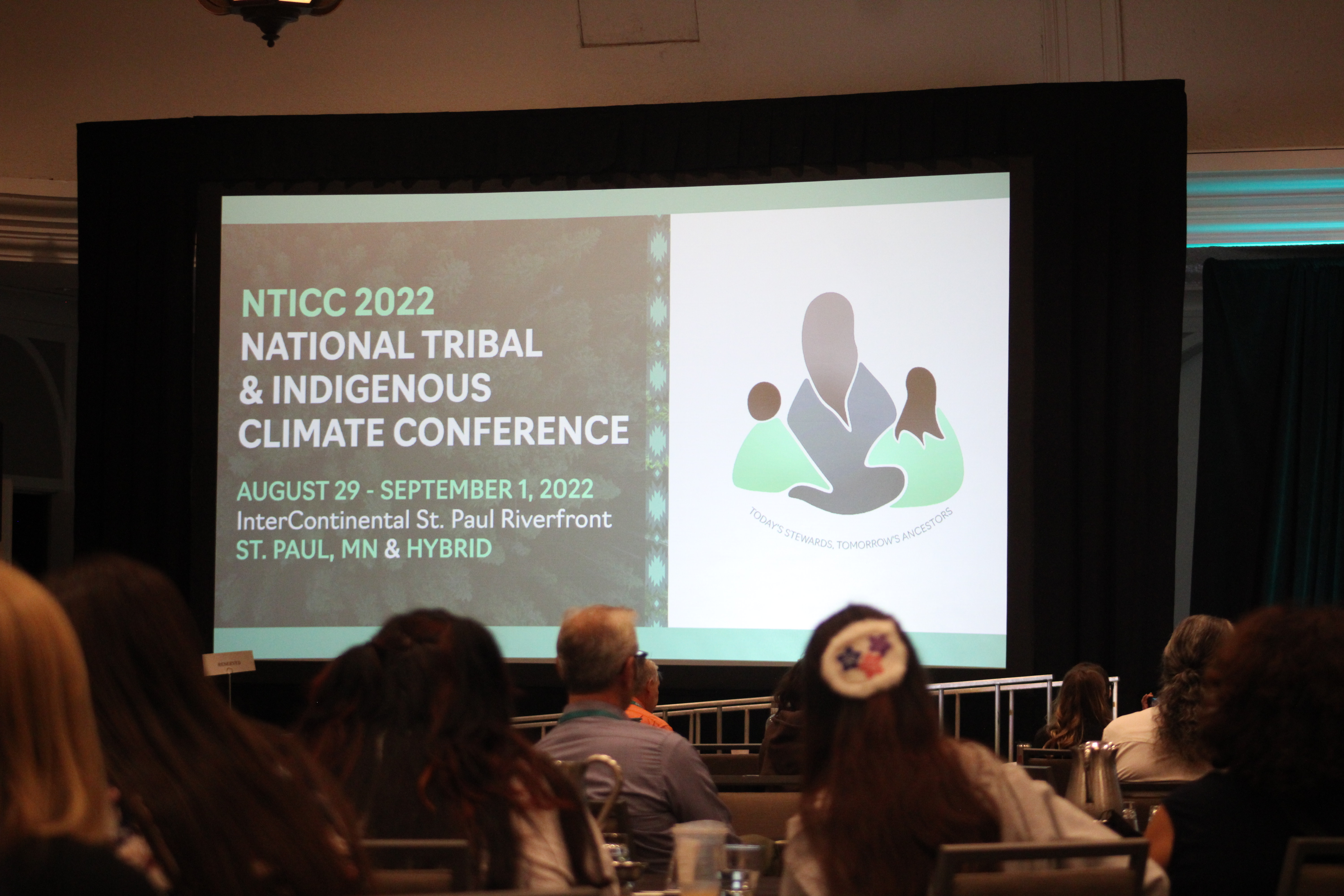
SAINT PAUL, Minn. — Today, more than 700 people from as far as New Zeeland and Australia attended the National Tribal & Indigenous Climate Change Conference (NTICC) at the Intercontinental St. Paul-Riverfront, owned by the Mille Lacs Band of Ojibwe.
The four-day conference, which kicked off on Monday, is organized by the Institute for Tribal Environmental Professionals (ITEP) and the Bureau of Indian Affairs (BIA) Tribal Resilience Program. Programming focuses on sharing knowledge about climate change with an emphasis on honoring traditional and Indigenous ways of life.
"The Mille Lacs Band of Ojibwe waited two years to host this conference, and we are so honored to be here," said ITEP's Executive Director Ann Marie Chischilly during Tuesday's opening plenary session.
Chischilly also mentioned that the Covid-19 pandemic put a pause on hosting the conference in person in 2020, and this is the first in-person event for the biennial conference.
Programming features workshops and training on various environmental topics around reducing carbon emissions, wildlife and habitat restoration, food sovereignty, fish and aquatic ecosystem recovery, Indigenous climate frameworks, and more.
"According to a report released by the United Nations a few years ago, Indigenous people are the most vulnerable to climate change," Mic Isham, executive director of the Great Lakes Intertribal Fish & Wildlife Commission, said during the opening session. "So, I asked our elders what they thought of this release, and their response was what gave me hope ... our culture has survived addictions, starvation, chemical warfare, illness, and boarding schools. They said that we are not the most vulnerable, but the most likely to survive — and that's what gave me hope for the future."

With increasing fires in California and New Mexico, conversations about how to reduce their threat is a point of emphasis at this year's conference. Native Americans, Alaska Natives, and Native Hawaiians have traditionally used fire to manage land and promote ecological diversity, but the practice was suppressed in the 1900s due to government land-management policies. However, over the last few years, cultural burning has reduced the risk of catastrophic wildfires that have been consuming many areas throughout the country.
"Indigenous peoples have shaped and maintained California ecosystems, which include coastal prairies, valley oak savannas, and montane meadows," said Melinda Adams, one of the presenters at the conference and professor at the University of California-Davis.
Presenting co-hosts included Great Lakes Indian Fish & Wildlife Commission, NDN Collective, and the Mille Lacs Band of Ojibwe. In addition, the National Indian Carbon Coalition, the United States Geological Survey, Federal Emergency Management Agency (FEMA), and NDN Collective exhibited during the conference.
NDN Collective also sponsored nine youth nationwide to attend the conference and learn from mentors. The organization is paving paths for renewable energy on tribal lands. NDN Collective's Climate Change Director Jade Begay hopes to become regional and national models that protect cultural lifestyles and build local economies.
"Our participation at the conference was to support youth and encourage their learning," Begay told Native News Online. "One of NDN Collective's Climate Change goals is to elevate Indigenous people as the experts on climate change."
The conference also partnered with ReNew Earth Running and Native Women Running for attendees to build community and partnership each morning of the conference.
"It is our hope for those attending the conference that they will hear from our frontline workers, the people who are living and breathing our environment," ITEP's Interim Assistant Director Nikki Colley told Native News Online.
More Stories Like This
Gwich'in Tribal Governments Submit Comments Challenging Fish and Wildlife Service's Inadequate Environmental Review of Arctic Refuge Snow RoadRappahannock Tribe Challenges 9M-Gallon Water Plan
Feds release draft long-term plans for Colorado River management
Apache Leader Walks 60 Miles to Court Hearing That Will Decide Fate of Sacred Oak Flat
Rappahannock Tribe Raises Sovereignty and Environmental Concerns Over Caroline County Water Permit
Help us defend tribal sovereignty.
At Native News Online, our mission is rooted in telling the stories that strengthen sovereignty and uplift Indigenous voices — not just at year’s end, but every single day.
Because of your generosity last year, we were able to keep our reporters on the ground in tribal communities, at national gatherings and in the halls of Congress — covering the issues that matter most to Indian Country: sovereignty, culture, education, health and economic opportunity.
That support sustained us through a tough year in 2025. Now, as we look to the year ahead, we need your help right now to ensure warrior journalism remains strong — reporting that defends tribal sovereignty, amplifies Native truth, and holds power accountable.
 The stakes couldn't be higher. Your support keeps Native voices heard, Native stories told and Native sovereignty defended.
Stand with Warrior Journalism today.
Levi Rickert (Potawatomi), Editor & Publisher