



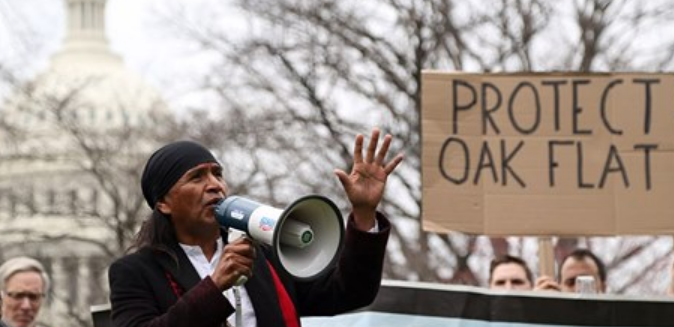
- Details
- By Joel Helfrich
Guest Opinion. Arizona is running out of water, yet we’re preparing to hand over hundreds of billions of gallons to a single foreign-owned copper mine.
The proposed Resolution Copper project, a joint venture of foreign mining giants Rio Tinto and BHP, threatens the viability of Superstition Vistas, 175,000 acres earmarked for master-planned development southeast of Phoenix that could attract nearly a million residents over the coming decades.

Whether or not one supports this scale of development, the math is unavoidable: both Superstition Vistas and the Resolution Copper mine depend on the same diminishing groundwater supply.
And under current Arizona law, the mine would win that competition.
Resolution Copper has pumped billions of gallons
Resolution Copper plans to pump up to 600,000 acre-feet of groundwater — nearly 200 billion gallons — to process ore and transport nearly 1.4 billion tons of toxic mine waste to a site called Skunk Camp, where it will be impounded behind a dam 490 feet tall and three miles wide.
To put the sheer size of the mining waste into perspective, consider that the weight of the U.S. Navy’s last Nimitz-class supercarrier weighed just more than 100,000 tons.
It would be as if Resolution Copper dumped more than one aircraft carrier worth of mine waste into the desert landscape each day for 30-40 years.
Meanwhile, the mine’s wellfield lies squarely beneath the Superstition Vistas planning area.
Arizona’s water laws exempt mining operations from the rules that apply to cities, homes and farms. Industrial users like Resolution Copper can pump as much groundwater as they want without having to replace what they take.
Indeed, since at least 2009, Resolution Copper has pumped 600 to 700 gallons of groundwater per minute out of the mine, resulting in the vanishing of billions of gallons already.
Its water use could make Superstition Vistas worthless
The impacts of Resolution Copper’s thirst would be severe. The U.S. Forest Service has warned that the mine’s groundwater withdrawals could lower the water table by more than 200 feet, causing land subsidence of two to more than four feet.
This threatens not only future infrastructure in the area, but also by my estimate a 20-mile section of the Central Arizona Project canal vital for delivering Colorado River water across the state.
Even the Arizona State Land Department — which is responsible for stewarding trust land, including the Superstition Vistas site — has raised red flags.
In formal comments on the mine’s environmental review, the department concluded that the water use proposed by the mine would cause more harm than good, undermining long-term land value and public benefit, especially to K-12 public education.
Arizona schoolchildren stand to lose at least $536 million, according to the department.
Nearby state trust land has recently sold for $156,000 per acre. If Arizona cannot entice developers to purchase land in Superstition Vistas due to lack of water, when it goes to auction, the total loss could reach more than $27 billion for the entire 175,000 acres.
Mining could throw aquifers even more out of balance
And the timing couldn’t be worse. The Phoenix Active Management Area, where the mine would operate, is already out of hydrological balance, according to the Arizona Department of Water Resources.
In nearby Pinal County, new housing developments have been denied because there’s simply not enough groundwater to meet long-term needs.
Resolution Copper has stored some Colorado River water in irrigation districts, but that water is not located near the mine’s wellfield. Meanwhile, local farmers are pumping that water to stay afloat as river allocations shrink.Opinion: Arizona must OK painful water cuts. What could possibly go wrong?
Banking water in one place while draining an aquifer in another is not a solution. In fact, it defies common sense.
This situation highlights the growing disconnect between Arizona’s water laws and water realities.
Arizona State University’s Kyl Center for Water Policy recently described metro Phoenix’s “safe yield” groundwater goal as a “myth” — and pointed to mining operations as contributors to aquifer depletion.
Don't let one mine undermine a full community's future
Superstition Vistas may be controversial to some.
But regardless of one’s views on growth and sprawl, there’s no justification for allowing one industrial project to undermine any community’s future, especially under a legal loophole that permits unlimited extraction in the middle of a water crisis.
The question isn’t whether Arizona should mine copper. It’s whether we can afford to do it without rules that protect our shared resources and prioritize long-term public needs.
We live in a desert. Water is life. Arizona’s future depends on treating it that way.
Joel Helfrich is a public historian writing a book about Apache struggles to protect Mount Graham. Reach him at [email protected].
Help us defend tribal sovereignty.
At Native News Online, our mission is rooted in telling the stories that strengthen sovereignty and uplift Indigenous voices — not just at year’s end, but every single day.
Because of your generosity last year, we were able to keep our reporters on the ground in tribal communities, at national gatherings and in the halls of Congress — covering the issues that matter most to Indian Country: sovereignty, culture, education, health and economic opportunity.
That support sustained us through a tough year in 2025. Now, as we look to the year ahead, we need your help right now to ensure warrior journalism remains strong — reporting that defends tribal sovereignty, amplifies Native truth, and holds power accountable.
 The stakes couldn't be higher. Your support keeps Native voices heard, Native stories told and Native sovereignty defended.
Stand with Warrior Journalism today.
Levi Rickert (Potawatomi), Editor & Publisher