- Details
- By Kaili Berg
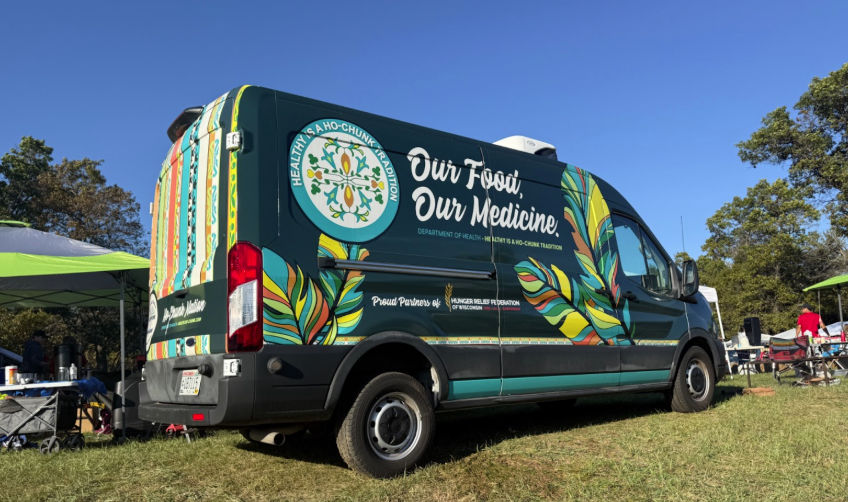
The smell of corn, venison, and wood smoke circled the air as the Ho-Chunk Nation gathered behind the Tribal Office Building for its annual Green Corn Celebration on October 9.
The celebration featured a community potluck, cooking and craft demonstrations, social and green corn dances, and cultural presentations focused on reconnecting with ancestral food and land practices.
“The green corn to me was often a dance that was held in the fall at each of our powwows,” Jon Greendeer, president of the Ho-Chunk Nation, told Native News Online. “I never really understood exactly where that derived from, because it wasn’t simply a dance.”

Around 2015, Greendeer began researching the origins of the Green Corn ceremony through conversations with elders and members of the traditional court.
“It was a little bit of a struggle at first, how you ask things and who you ask matters in Ho-Chunk country,” Greendeer said. “But I learned that the Green Corn was about celebrating the harvest season and the continuity of our people.”
Greendeer said the ceremony’s revival represents a return to pre-boarding school traditions.
“Replicating something that we had prior to the late 1800s was what I’d call a quantum leap into generations before,” Greendeer said. “We didn’t lose this tradition. We always say it went to sleep. And around 2017, it woke up.”
The Green Corn ceremony has roots throughout the Indigenous South and Midwest, where many tribal nations once gathered to mark the ripening of the corn crop, one of the first foods gifted by the Creator.
The celebration encouraged community members to share traditional dishes and revisit original food practices that existed before colonization. While contemporary menus often rely on processed and convenience foods, events like this reconnect people to the nutritional value of Indigenous foods.
“Traditional food practices have largely been modified into more contemporary comfort foods,” Greendeer said. “We’ve eliminated a lot of the processing that would normally be part of traditional gathering, it took a lot of work, a lot of time. Nowadays, people don’t always have the means or time to do that.”
Traditional dishes such as corn soup, venison, and squash-based meals were served, representing sustainable foods that once sustained the Ho-Chunk people for generations.
“What Green Corn does is take those wonderful foods we had before, takes them out of the gravy, out of the additives, and brings us right back to our first fireplaces,” Greendeer said. “People are re-tasting these again, and it’s waking something up inside them.”
Greendeer also noted that food sovereignty also depends on paying attention to natural cycles that determine when and how food should be gathered.
“When the corn is ready, it’s time to go do corn. When the rice is dropping, we go do rice. When the evenings drop below freezing, the maples are ready to give their sap,” Greendeer said. “These are our times. This is our clock.”
Across the Great Lakes region, projects such as Enbridge’s Line 5 pipeline continue to raise concerns about water protection and the long-term health of traditional food sources.
For many tribal nations, including the Ho-Chunk, the preservation of clean water is important in preserving food sovereignty. Environmental changes and industrial activities can also have lasting effects on those systems.
“When we have storms, pollution, or personal watercraft on our lakes, these things matter,” Greendeer said. “They affect the safety and quality of our food. Green Corn connects people not just to food, but to the entire food system.”
The celebration also reinforces intergenerational learning. Knowledge keepers shared language and traditional food preparation, while younger participants learned how to prepare, serve, and respect the ingredients used.
“The Green Corn is really about showing our gratefulness for the things we still have today,” Greendeer said. “And one day, when our Indigeneity is challenged, which it often is, we’ll be able to point to something like this and say, we are still Indigenous, we are still here.”
More Stories Like This
Northern Cheyenne Push Back Against Trump Administration’s Effort to Alter Little Bighorn HistoryFlorida Man Sentenced for Falsely Selling Imported Jewelry as Pueblo Indian–Made
Navajo Nation Declares State Of Emergency As Winter Storm Threatens Region
The Prediction Market Boom is Posing an Existential Threat to American Indian Gaming
NARF Condemns ICE Actions, Says Native Americans Unlawfully Detained
Help us defend tribal sovereignty.
At Native News Online, our mission is rooted in telling the stories that strengthen sovereignty and uplift Indigenous voices — not just at year’s end, but every single day.
Because of your generosity last year, we were able to keep our reporters on the ground in tribal communities, at national gatherings and in the halls of Congress — covering the issues that matter most to Indian Country: sovereignty, culture, education, health and economic opportunity.
That support sustained us through a tough year in 2025. Now, as we look to the year ahead, we need your help right now to ensure warrior journalism remains strong — reporting that defends tribal sovereignty, amplifies Native truth, and holds power accountable.
 The stakes couldn't be higher. Your support keeps Native voices heard, Native stories told and Native sovereignty defended.
Stand with Warrior Journalism today.
Levi Rickert (Potawatomi), Editor & Publisher