- Details
- By Native News Online Staff
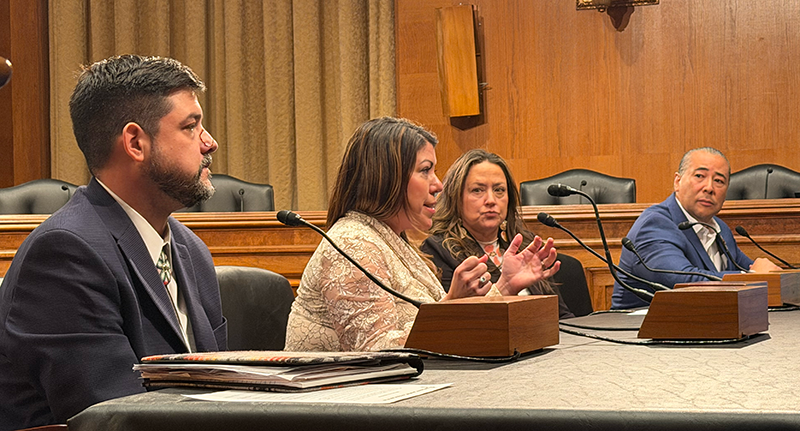
The Indian Gaming Association hosted a congressional briefing last Wednesday in the Senate Committee on Indian Affairs meeting room on Capitol Hill, warning lawmakers of what tribal leaders described as the most significant threat to Indian gaming since passage of the Indian Gaming Regulatory Act.
Opening the briefing, Chairman Dave Z. Bean, delivered pointed remarks outlining what he called the urgency of the moment.
“Sports event contracts being offered through prediction markets are the biggest threat to Indian gaming since IGRA was introduced to restrict Indian Gaming,” Bean said. “They are not innovative financial tools. They are illegal sports betting products being routed through futures exchanges to avoid gaming law. That is a direct attack on tribal sovereignty.”

The session brought together the IGA/NCAI Task Force, leaders from the National Congress of American Indians, including President Mark Macarro, tribal leadership, state and national gaming associations and consumer protection experts. Speakers focused on the rapid growth of sports event contracts offered under oversight of the Commodity Futures Trading Commission.
Tribal leaders told members of Congress that the contracts are being listed on futures and derivatives markets originally designed to help farmers manage crop risk and were never intended to function as nationwide sportsbooks.
“These products are for sports betting. They walk like sports betting. They pay out like sports betting. The only difference is that they are being dressed up as financial swaps to evade regulation,” Bean said.
Panelists contrasted the contracts with tribal and state-regulated sportsbooks, citing what they described as major gaps in oversight and consumer protection. They said the platforms lack geofencing technology, allowing them to bypass a tribe’s authority to determine who operates on its lands. They also cited an absence of meaningful consumer protections, no uniform age-verification requirements and no revenue sharing with states or tribes.
Tribal leaders pointed to controversy following the recent Super Bowl, when the CFTC received complaints over disputed wagers and outcome determinations. They said the incidents highlight a lack of regulatory clarity and safeguards that are standard in tribal gaming operations.
A tribal leaders panel moderated by IGA Executive Director Jason Giles featured Chief Kirk Francis of the Penobscot Nation and Councilwoman Hermenia Frias of the Pascua Yaqui Tribe. The leaders said gaming revenue funds essential services, including health care, housing, education and public safety.
“Prediction markets provide no benefit to tribal communities,” Bean said. “They extract value without consent, without compacting, and without accountability.”
A gaming association panel included Bean, Phil Brodeen of the Minnesota Indian Gaming Association, Rebecca George of the Washington Indian Gaming Association and Alex Costello of the American Gaming Association. Speakers said the tribal and commercial gaming sectors are aligned in opposition.
“The entire gaming industry, commercial and tribal, is united,” Bean said. “Tribal nations are unified with States to stop this illegal betting market. We are asking Congress to step in before irreversible damage is done to state and tribal budgets and our citizens' livelihoods.”
Tribal leaders also raised concerns about the CFTC’s position that sports event contracts are not illegal under the Commodity Exchange Act. Recent comments by CFTC Chair Rostin Behnam, whose term recently ended, and ongoing litigation surrounding prediction markets have further heightened tensions between regulators and tribal governments.
Bean said administrative action cannot replace congressional authority.
“Congress established the framework for gaming in this country. If federal regulators reinterpret commodities law to authorize nationwide sports betting, that undermines Congress, undermines States and Tribes, and undermines the rule of law,” he said.
IGA and its partners are urging senators to include clarifying language in pending cryptocurrency marketplace legislation affirming that the Commodity Exchange Act does not authorize sports wagering through derivatives markets.
As part of the advocacy effort, lawmakers were asked to sign a bipartisan letter to the CFTC calling for stronger oversight of prediction markets.
Bean closed the briefing with a warning.
“Tribal gaming is the most regulated form of gaming in the United States. We built this industry responsibly under IGRA. We negotiated compacts. We follow strict regulatory standards. We share revenue. What we are seeing now is an attempt to bypass all of that. Indian Country will not allow illegal gambling to erode decades of hard work and sovereignty.”
The Indian Gaming Association said it will continue working with tribal governments, gaming associations and members of Congress to ensure federal law is enforced and tribal rights are protected.
More Stories Like This
Navajo Resources and Development Committee Issues Notice on Livestock Inspection RequirementsAmerican Prairie, Tribal Coalition Files Protest Over Rescinded Grazing Rights
Northern Cheyenne Push Back Against Trump Administration’s Effort to Alter Little Bighorn History
Florida Man Sentenced for Falsely Selling Imported Jewelry as Pueblo Indian–Made
Help us defend tribal sovereignty.
At Native News Online, our mission is rooted in telling the stories that strengthen sovereignty and uplift Indigenous voices — not just at year’s end, but every single day.
Because of your generosity last year, we were able to keep our reporters on the ground in tribal communities, at national gatherings and in the halls of Congress — covering the issues that matter most to Indian Country: sovereignty, culture, education, health and economic opportunity.
That support sustained us through a tough year in 2025. Now, as we look to the year ahead, we need your help right now to ensure warrior journalism remains strong — reporting that defends tribal sovereignty, amplifies Native truth, and holds power accountable.
 The stakes couldn't be higher. Your support keeps Native voices heard, Native stories told and Native sovereignty defended.
Stand with Warrior Journalism today.
Levi Rickert (Potawatomi), Editor & Publisher