



- Details
- By Shaun Griswold
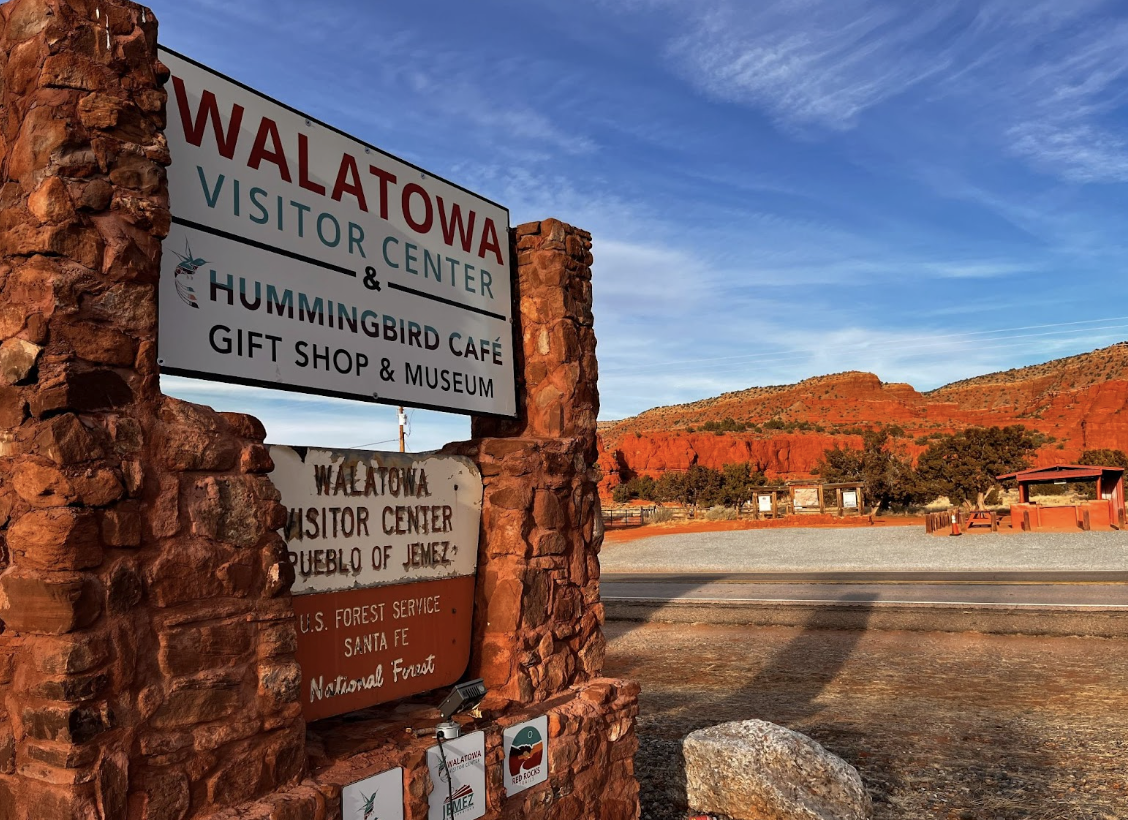
As the eagle dancers finished their final prayer before the hundreds gathered at the Jemez Pueblo plaza on Tuesday, Jan 6, the annual Three Kings Day Feast, they were swooped atop the shoulders of ceremonial leaders, beginning a bond between the dancer and the family of the person carrying them indoors.
This act is a kinship relationship rooted in ceremonies foundational to Pueblo sovereignty that predate European colonization in what is now the American Southwest.
After all the eagle dancers move indoors, buffalo and deer dancers continue to dance on the beat of the drums in one of two distinct kiva homes, Pumpkin and Turquoise. These kivas are spaces for prayers and meetings, and also identify Jemez family relationships. The dozens of men behind the drummers finish their song from the Turquoise side and walk off the plaza to nearby homes as the Pumpkin side begins their turn.
The history
Each year on Jan 6, many of the 19 Pueblo nations across New Mexico hold a Three Kings Day Feast to honor tribal sovereignty with public ceremonies to usher in new government and religious leadership. The day is a lesson in the deep cultural and political history of the Pueblo’s.
“We celebrate because we can, we dance because we can, we sing because we can, and we talk because we can,” Pueblo historian Jon Ghahate (Zuni/Laguna) said about the day. “We as Pueblo peoples are of this place, because of those who have preceded us.”
The Three Kings Day Feast ties the Catholic calendar — the 12th day after Christmas marking when the Three Wise Men completed their journey to witness the birth of Jesus — with many of the Pueblos’ religious and agricultural events.
Catholicism and Pueblo sovereignty hit an apex under Spanish and Mexican rule. The Pueblo Revolt of 1680 cemented Pueblo liberty to culture and land in the area through self-governance even after the post-Spanish reconquest. Pueblo rights remained elemental after the United States signed the Treaty of Hidalgo in 1848, which granted U.S. citizenship to anyone living in the Western territories acquired from the war with Mexico. These rights were not immediately granted to the Pueblo people; however, due to existing agreements that spanned generations with two different colonists, the Pueblos practiced an early version of government-to-government relationships, an anomaly for U.S. tribal relations at the time.
In the historical review titled, “Pueblo Indians and Citizenship in Territorial New Mexico,” Deborah A. Rosen identified this conundrum: “The United States had no ready policy for agricultural Indians — such as the Pueblos — living in towns, nor did the government act quickly to clarify the Pueblo Indians' status. Remaining unclear for many years was whether the Pueblo Indians were to be treated the same as other U.S. Indians or were to have the rights of U.S. citizens.”
As the U.S. government was deep into its brutal national Indian affairs Removal Policies, it was determining how Pueblo sovereignty would fit into the future of the country. The Civil War would provide an opportunity for the Pueblos to gain support within the U.S.
In 1864, all 19 Pueblos in the New Mexico territory received a gift from the White House: a cane made from ebony wood that was topped with silver, engraved with the name of the Pueblo and the marking, “A. Lincoln.”
Indian Affairs Superintendent Michael Steck commissioned the canes after he noticed in organizational meetings that Pueblo leadership carried canes to symbolize those in charge. Two of those canes represented the Spanish and Mexican rule, so Steck saw an opportunity to blend established Pueblo cultural governance with the new U.S. system.The canes were made in Philadelphia for $5.50 each, with approval from President Abraham Lincoln’s administration, according to research by Martha LaCroix Dailey. In Philadelphia, John Dold mounted the silver and engraved Lincoln’s name.
On Sept. 16 and 20 in 1864, the Lincoln Canes were delivered to the Pueblos of Cochiti, Zia, Santa Ana, Santo Domingo, San Felipe, Sandia, Isleta, Jemez, Laguna, Acoma, and Zuni. By Dec. 1864, the eight additional canes were delivered to Tesuque, Pojoaque, Nambe, San Ildefonso, Santa Clara, San Juan, Picuris, and Taos Pueblos.
Historians cannot pinpoint an exact reason why President Lincoln’s administration sent the canes, but his commitment to preserving the Union during the Civil War by any means necessary did give him incentive to consolidate support wherever it existed.
This history is deeply explored by historians and Pueblo leaders in the 2021 documentary “Canes of Power.” Before his death in 2023, Ohkay Owhingeh Pueblo leader Joe Garcia gave his reason for why the Lincoln Canes exist.
“President Lincoln did not do it out of the kindness of his heart, it was more of an urging by tribal leaders and a tribal organization,” Garcia said in the documentary. “In this case, we're talking about an organization that existed since 1598, All Indian Pueblo Council. There lies the importance of why the canes are held with such high respect.”
The theory that the canes were a symbol of Pueblo sovereignty is supported by land permits dated 1864 — the same year the canes were gifted — that outlined Pueblo territories still in use.
The Supreme Court opinion in United States v. Joseph in 1877 would further secure Pueblo rights to land, which would remain precedent for current natural resource entitlements for the tribal governments, including water and mineral rights. To this day, these remain paramount to the foundational success of any Pueblo government.
Justice Samuel Freeman Miller, a Lincoln appointee, wrote positively for Pueblo self-governance by affirming arguments made by their attorneys, who told the Court that “the Pueblo Indians have lived in villages, in fixed communities, each having its own municipal or local government. As far as their history can be traced, they have been a pastoral and agricultural people, raising flocks and cultivating the soil. Since the introduction of the Spanish Catholic missionary into the country, they have adopted mainly not only the Spanish language, but the religion of a Christian church. They manufacture nearly all of their blankets, clothing, agricultural and culinary implements. They are as intelligent as most nations or people deprived of means or facilities for education.”
In 2026, these practices continue forward.
Pueblo resiliance
For most Pueblos, the Three Kings Day Feast typically starts with a morning traditional Catholic mass before the eagle, buffalo and deer dancers begin their ceremonies. During the mass, new tribal leaders are presented with the three canes. The Lincoln Cane is held by the elected or appointed Pueblo governor, while the Mexican and Spanish canes go to their two lieutenant governors. The canes are held at the leader’s home and carried with them as a symbol of their position. In some instances, it is the credential they need for admittance into Pueblo Council events. For most, their service will last one year.
The Pueblos invite federal, state and local officials to get acquainted with the leadership group. This year on Jan.6, the city of Albuquerque sends representatives to several Pueblos to “offer support and expertise, when necessary, and continue to learn from our neighbors,” Terry Sloan, Intergovernmental Tribal Liaison at the city of Albuquerque, said. “We also have built a city team that represents tribal perspectives and works to share those perspectives within the city.”
This is another marker of the impact of Pueblo governance that spans centuries.
“It is an acknowledgment of the fundamental sense of Pueblo society, community servitude, and it is a proclamation of taking ownership of our pueblo self-governance,” Ghahate said. “It is the narrative of our Pueblo resilience, and the continuance of our Pueblo communities, our Pueblo culture, our heritage, our legacy, and our human rights as Pueblo peoples. Democracy is not solely an Eastern hemisphere construct.”
More Stories Like This
‘This is who we are’: Northern Cheyenne Tribe reclaims cultural belongings from UMIndian Gaming Association Condemns CFTC Over Prediction Markets, Warns of Threat to Tribal Sovereignty
Committee Advances 20% Increase to Navajo Child Support Guidelines
Navajo Committee Advances $84M Transportation Improvement Plan
NCAI Passes Two Emergency Resolutions on Immigration Enforcement Activities
Help us defend tribal sovereignty.
At Native News Online, our mission is rooted in telling the stories that strengthen sovereignty and uplift Indigenous voices — not just at year’s end, but every single day.
Because of your generosity last year, we were able to keep our reporters on the ground in tribal communities, at national gatherings and in the halls of Congress — covering the issues that matter most to Indian Country: sovereignty, culture, education, health and economic opportunity.
That support sustained us through a tough year in 2025. Now, as we look to the year ahead, we need your help right now to ensure warrior journalism remains strong — reporting that defends tribal sovereignty, amplifies Native truth, and holds power accountable.
 The stakes couldn't be higher. Your support keeps Native voices heard, Native stories told and Native sovereignty defended.
Stand with Warrior Journalism today.
Levi Rickert (Potawatomi), Editor & Publisher