



- Details
- By Hailey Bosek, Medill Reports
In the waiting room at Sean Sherman’s (Oglala Lakota) Minneapolis restaurant, Owamni, a crowd gathers around the front desk. A seat doesn’t come easy here, so eager patrons, young and old, arrive early to earn a coveted spot at the riverside restaurant.
This article was originally published in Medill Reports Chicago.
Three older women stand closest to the hostess.
“We are BIG fans,” one of them said. The three-time James Beard Award winner has become a culinary star, complete with his own admirers. When the group is seated, they prop a wrinkled magazine picture of Sherman at the head of their table.
“Well, people watch him; he’s well-known,” Executive Chef Lee Garmen said.
The real surprise comes when Sherman himself walks into the dining room. The women giggle like schoolgirls as he kneels at their table for a photo.
What Owamni and other Native chefs are doing is “ironically foreign,” co-owner Dana Thompson told The New Yorker.
“The things we are doing with game, it’s unlike anything anyone else is doing,” Garmen said.
The Native concept behind the restaurant is special, but Sherman dreams of the day it becomes less of a novelty and more of a standard.
Indigenous cuisine is not easily defined. Some point to frybread — a crispy-on-the-outside, soft-on-the-inside staple. Others highlight hearty bison or gamy venison as Native food.
While Indigenous restaurants exist in the United States, the numbers remain small, making it one of the least represented cuisines in the food scene. Many Americans don’t even know what Native food is. Despite the trauma of colonization and the loss of ancestral cultural knowledge, Native chefs across the country are working to change that, raising awareness of Indigenous cuisine through education that centers on health, history and culture.
Recognition beyond the reservation
Sherman, 51, is an undeniable leader in the growing movement to raise awareness of Native food, but he wants to make it clear he’s not the only one.
“There’s a lot of people out there. I’m not trying to take the — I get a lot of attention, but it’s not about me, you know? We just use that attention to help us grow, yeah?” Sherman said.
Sherman grew up on the second-largest reservation in the U.S., the Pine Ridge Reservation. Sherman describes the beauty of mountain ranges and vast plains that stretch on seemingly forever, spanning more than 2 million acres in the Black Hills of South Dakota.
The Pine Ridge Reservation also deals with significant challenges. According to data compiled by Re-member, a nonprofit organization dedicated to advocating for the residents of The Pine Ridge Reservation, Oglala Lakota County is one of the poorest counties in the nation, with more than 80% of its population facing unemployment. Infant mortality is high, and life expectancy is low. Food security is another major problem, with more than 90% of food on the reservation being shipped in.
Sherman moved off the reservation when he started high school but began working in kitchens right away.
“I moved to Minneapolis, thinking I was gonna be an artist, but I ended up just working in restaurants,” Sherman said. “I just crawled my way eventually into a chef position.”
Sherman was young for a chef, only 27. He worked in European and contemporary restaurants. At the time, Native American cuisine wasn’t even a category. It wasn’t until decades later he began asking himself a pivotal question.
“I just wanted to really understand what were Native foods, and what were Native foodways,” Sherman said.
In 2017, Sherman founded the North American Traditional Indigenous Food Systems, a nonprofit culinary organization that is as ambitious as it is expansive. The group’s mission is “addressing the economic and health crises affecting Native communities by re-establishing Native foodways.” Through its Indigenous Food Lab, markets, professional training kitchen and educational programs, Sherman and his team of nearly 130 people — most of them Native — work to carry out that mission.
“So it’s lofty goals, but we see a very clear path, and that’s just what we’re doing,” Sherman said.
Perhaps the biggest part of NATIFS is Sherman’s nonprofit restaurant, Owamni. Settled on the banks of the Mississippi River, signs on the road leading to the restaurant in downtown
Minneapolis remind visitors:
You are on Native land.
Owamni serves up a “decolonized” menu, free of ingredients brought by colonizers. That means no pork, chicken, beef, dairy, sugar, salt or pepper. The ever-shifting menu changes with the season and what’s available locally. Sherman says Owamni introduces the general public to the Indigenous ingredients of North America while expanding Native foodways.
Still, Owamni is only one part of the NATIFS mission. Sherman said he believes his restaurant and others have helped normalize Indigenous cuisine while creating financial opportunity for Native people.
“I use the restaurant as a place that creates a lot of jobs, and as a place that intentionally moves a lot of food dollars to who we want to support,” Sherman said. He explained more than $500,000 goes toward Indigenous producers.
One morning, a morning manager walks into the cramped backroom where chef Lee Garmen is preparing for the night ahead.
“Need a smudge?” she asks.
“Yeah, it seems like we are really gonna need it tonight,” Garmen replies.
The earthy scent of sage fills the air as he cleanses himself with the soothing aroma. Garmen was right, he would need it, since it was going to be busy. Owamni has been booked every night since it opened in 2021.
“There is absolutely an audience for this,” Garmen said.
A ritual for the team at Owamni, smudging is a Native practice that helps cleanse a person, place or object of any negative energy. (Hailey Bosek/MEDILL)
The concept behind Sherman’s project brings in large crowds — and awards don’t hurt his reputation either. His work, along with that of other Native chefs, has sparked the emergence of new projects. Sherman said when he first began researching Indigenous food systems, he found fewer than 15 Indigenous chefs in the entire country. Today, there are many established and up-and-coming chefs, some of whom he has mentored, and more Native food businesses open each year.
Now, thanks to chefs like Sherman, publications are publishing lists of the best places to find Native food. The movement includes more than just brick-and-mortar restaurants: Pop-up venues, catering, museum cafés and tribal-run spots are part of the mix. That makes it hard to pin down exactly how many places serve Native food cooked by Indigenous people. Through way of teach-ins, cookbooks and even cooking show wins, the movement to normalize and increase awareness has fiercely grown.
“We’re really proud to be a part of all these Native chefs around the country who are growing and taking on their own focuses,” Sherman said.
Despite this growth, Native restaurants remain rare in the overall food scene. The scarcity reflects deeper historic, cultural and economic injustices that have limited their proliferation. Sherman says the small numbers stem not just from lack of awareness of Indigenous cuisine, but also from the lack of historical education about Native people themselves.
“A big reason why we don’t see Native American restaurants all over the country is just because of this history that we have lived through that’s still very, very recent,” Sherman said. “We live in such a whitewashed history of things that our knowledge base of just a basic American history is uplifting colonial powers, without ever considering the harm or damage that happened to people outside of that bubble.”
The displacement of Native Americans from their homelands onto reservations in the late 19th century meant they lost more than land. The disconnect from traditional food sources and systems destroyed ancestral knowledge. This disconnect is further emphasized as traditional food sources like the buffalo were decimated for sport. The ability to hunt, fish and forage was replaced by rations and commodities.
David Beck, a professor of American Indian history at the University of Illinois Urbana-Champaign, said Native people’s access to fresh food was historically restricted.
“Most reservations are food deserts, like inner cities are … maybe even to a greater extent. So getting any fresh foods is very, very difficult,” Beck said. “On top of the lack of access to fresh food, any government rations, often called commodities, were often spoiled or lacked any nutritional value.”
Beck said the lack of access on reservations is one reason Native and non-Native people alike are unaware of Indigenous foods. Sherman added cultural suppression also played a role.
“Being forced into boarding schools for decades erases a lot of Indigenous knowledge. Indigenous education would have been understanding the names and the purposes of all these plants and trees, and how to live a lot more symbiotically with our region. Basically, like the ‘how-to manual’ for what to do in North America,” Sherman said. “That’s all kind of wiped out the window, and it’s replaced with Christian values.”
In his own community, Sherman said, the replacement of ancestral knowledge with Christian values left many families reliant on food programs.
OK, so what is Native food?
The Chicago Pilsen Powwow is in full swing. A sweet harmony rises from the steady drumbeat and the jingle of a thousand tiny bells on the skirts of dancing women. The event, sponsored by the American Indian Center of Chicago, is an intertribal celebration of the city’s Indigenous culture.
Amid the symphony of sounds comes a smell from the corner. Three chefs rush around a small tent, moving like a well-tuned orchestra. There is motion, a blur. Bodies move quickly, forming their own type of dance of seasoning, plating, adjusting and, above all else, sweating. The scent of slow-braised buffalo fills the air. A line of people snakes around the park, where the aroma of El Milagro tortillas is so strong the last person in line could almost taste it.
The food is gone in less than an hour and a half. For the crowd of community members, elders and Natives from across the Midwest, food remains central to connection at the powwow. Yet despite its popularity in this space of beating drums and chanting voices, it’s a rarity to find this food in Chicago outside such gatherings.
The tent at the Pilsen Powwow bears the name Ketapanen Kitchen. Ketapanen is an expression of love in the Menominee Nation. Chef Jessica Walks First (Menominee Indian Tribe of Wisconsin) is a Cordon Bleu-trained chef and the owner of the catering company, the first to offer Native American cuisine in the state, which might explain her popularity here. On the menu: bison and cedar-braised chicken tacos, herbal lemonade and watermelon.
A woman in line tells her friend she has “never had Native American food before.”
“What are they even serving?” another patron asks. The confusion isn’t surprising—there is no single answer.
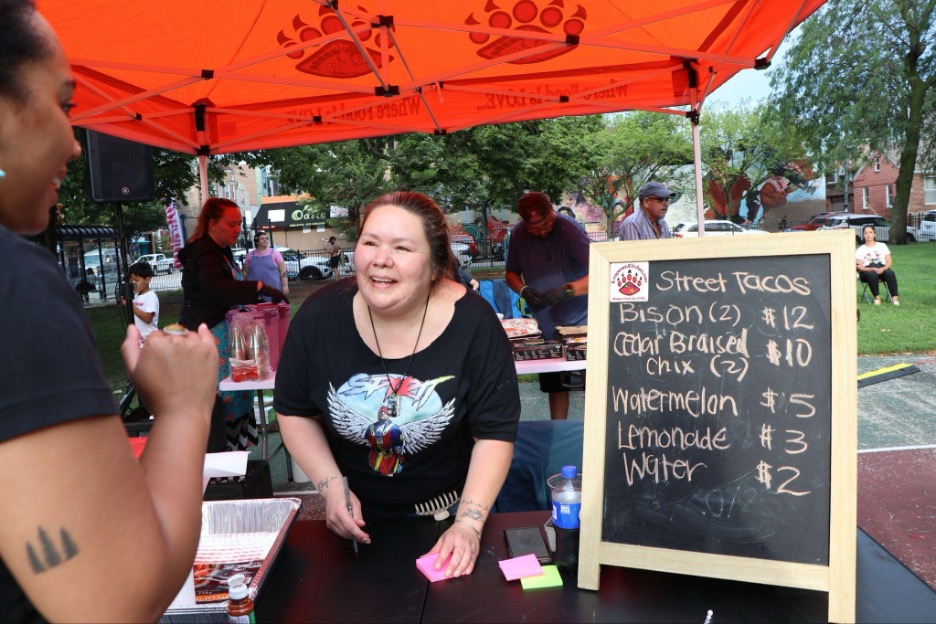 Chef Jessica Walks First smiles at a patron at the American Indian Center Chicago powwow. (Hailey Bosek/MEDILL)
“Honestly, there’s no clear definition, and everyone has their own definition,” Walks First said.
That question is exactly what Lois Ellen Frank has been researching for 30 years. Frank (Kiowa Nation) is a chef, author, historian and James Beard Award-winner based in Santa Fe.
There are nearly 600 federally recognized tribes, and another 400 that are not recognized, in the United States alone. Native Americans are not a monolith, and neither are their cooking traditions.
“It’s really hard to just lump and say there’s one cuisine. It’s like in Italy — Northern Italy has completely different cuisine than Southern Italy,” Frank said.
Frank stresses the importance of understanding the differences between traditional and contemporary recipes, and categorizes them in eras.
“So we can contextualize by saying the food is regional, but also we have to look historically over time,” she said.
She defines these eras as precolonial contact, first contact and government rations on reservations — markers that help explain how foods and traditions evolved. The best way to define ancestral Native cuisine, she said, is to look at the plants and animals native to a specific area. Like any other culture, things became more complicated when cultural exchange occurred — sometimes consensual, sometimes forced — as assimilation reshaped traditions and lifestyles.
Chef Walter Whitewater (Diné), who co-owns Red Mesa Catering with Frank, describes the shifts he has witnessed in food over time on the reservation.
“The way the food used to look — it’s changed from today. It continues to change. It’s like a song, and even the drum beats start to change, even the ceremony starts to change,” Whitewater said. “For me, you have to ask, what is Native? What was Native?”
Miri Eliyahu, an economic sociologist specializing in the food industry, said each era of food — both pre- and post-contact — represents a community effort to recreate the feelings their ancestors experienced when gathering.
“Food is culture,” Eliyahu said. “Communities create and recreate culture all the time.”
Walks First said she believes adaptation is integral to Native cuisine. Her menu includes wild rice dishes, savory bison burgers and brisket, and her popular tamales, filled with Indigenous flavors such as blueberry and cranberry masa with turkey or bison.
“The dishes, the ingredients, they seem to have changed — but it is still the essence of us,” she said.
So yes, Native food is corn, salmon, berries and buffalo. Local plant life and Indigenous game, such as venison or salmon, represent the traditional foods Sherman serves. But like every other cuisine, Native food is adapting with each generation. That evolution makes Indian tacos and frybread an important part of the cultural cuisine of Indigenous peoples in the U.S.
Frybread: A complicated icon
Awareness of Native cuisine is still lacking. Poor education, barriers to entry and historical suppression have led to an absence of Native restaurants and cultural representation.
But there is one dish many non-Natives recognize.
“Have you had frybread? You have gotta try frybread,” said Arturo Zavala (Purépecha tribe), a participant at the American Indian Center Chicago powwow.
Many call it a staple at gatherings or powwows. But frybread carries complicated feelings — nostalgia and community on one hand, a reminder of a painful past on the other.
Made from white wheat flour, water, yeast, baking powder and salt, frybread is deep fried in oil or lard, sometimes finished with honey or powdered sugar. These base ingredients came from government rations on reservations.
“Yeah, it’s a survival food. And I mean, its nutritional value is almost nonexistent, but it was something to keep people from going hungry,” Walks First said. Frybread, she explained, reflects both resilience and the health crises Native communities face. A single serving can pack more than 700 calories and 27 grams of fat.
“For lack of a better word, it was shit in a can,” Walks First said. “We had to learn what to cook with what went there. So a lot of the dishes we have — they’re not healthy, but it’s something we’ve grown accustomed to.”
Many Native chefs describe frybread as a food born of adaptation and survival. It has also become a cultural symbol, appearing in movies like “Smoke Signals,” shows like “Reservation Dogs” and “Yellowstone,” and even on “Diners, Drive-Ins and Dives.”
Ironically, despite its iconic Indigenous status, none of its ingredients are Indigenous to North America.
“But people embraced it. It became a thing, and people love it,” said Sean Sherman, James Beard Award winner and founder of Owamni. “But I also feel like that one piece shouldn’t identify every Native American group when it comes to their foods, because everybody has so much uniqueness.”
At Owamni, Sherman serves a decolonized menu free of any ingredients brought over by European colonizers. Frybread is absent.
“I mean, there’s nothing wrong with it. It has a story. It’s ingrained, and we just chose not to do it because it didn’t fit in with the philosophy we chose,” Sherman said.
Other chefs also push back. “Frybread, I mean, that’s colonization already. It’s (wheat) flour,” said Molina, programs director at the American Indian Center of Chicago, who avoids flour in his cooking.
But some, like Vernon Defoe, executive chef at Gatherings Cafe, argue for nuance.
“I’ve noticed that people newer to the culture are the ones a little more sensitive to frybread, because they probably learned the historical value before they’ve experienced the cultural value,” Defoe said.
At Owamni, sous chef Deryll Montana, who once helped start a restaurant in Arizona called the Frybread Lounge, suggested treating frybread like a birthday cake.
“It is maybe something you don’t eat more than a couple times a year,” Montana said.
Love it or hate it, frybread is undoubtedly the most recognizable piece of Native cuisine.
“Yeah, it is a sad story, but it’s also a story of survival,” Defoe said.
Barriers to entry
The avenues of support for Native Americans are few and far between, and this holds true for chefs as well. Native Americans experience the highest poverty rates of any minority group.
“When you’re trying to borrow money, you don’t have any land you can put up for collateral, because the land belongs to the United States,” Beck said, referring to Natives who tried to own on the reservation.
The lack of ownership, along with other barriers for Natives on and off the reservation, means there is little to no cultivation of generational wealth.
“Oh, there’s no generational wealth because it was all stripped. There’s no rich family member to call on to borrow some money to have some business,” Sherman said. He explained the lack of wealth in reservations and Native communities also means there is little education on what to do if you actually have money.
“You don’t really learn about money, if at all, in life. There’s not a lot of training on what to do with money and credit scores and banking systems,” Sherman said.
Loans are often crucial in creating a restaurant, where upfront costs can range from $95,000 to $2 million. Walks First said obtaining a small business loan was challenging. The Small Business Administration required two years of financial documents to get certified as a minority-owned business. But as a new business, she couldn’t provide those documents, creating a catch-22 situation.
“I did it all on my own,” Walks First said. “I literally started my business with $500 in my pocket, a hope and a prayer.”
Without a loan, starting a business, especially in the food industry, can feel impossible. Eliyahu explained even the most successful chains are shuttering.
“The food business in general is a brutal business. Expecting marginalized communities to turn a profit in that industry almost sounds insane to me,” Eliyahu said.
Sherman echoed that sentiment, saying the business is “finicky” because of its small profit margins. He added the risk is high, but more and more Native chefs are taking it anyway.
Food sovereignty
The front of the newly renovated Minneapolis American Indian Center. (Hailey Bosek/MEDILL)
At the Gatherings Cafe, a nonprofit restaurant connected to the Minneapolis American Indian Center, breakfast is being served. The cafe opened last summer, but Executive Chef Vernon Defoe (Red Cliff Tribe) is already preparing for a live food demonstration at an upcoming Indigenous farmers’ market.
Defoe finds it difficult to rely entirely on Native food systems in an urban center. But at the market, he can interact with and support other Native vendors. The Four Sisters Farmers Market serves as an affordable access point to local Indigenous goods. Defoe said participating in these markets fulfills the vision of Gatherings Cafe’s mission.
The food sovereignty movement is another philosophy guiding chefs as they develop new projects. Defoe said food sovereignty values the right of Indigenous people to control their food pathways, something they have historically been denied.
“It means, like, being able to have autonomy with our own culture,” Defoe said. He explained connecting food pathways and supporting Indigenous suppliers allows Native people to make their own decisions about what they are eating and where they are getting their ingredients.
Walks First explained the food sovereignty movement fosters a mentality of deeper connection to the earth.
“The spirit of every ingredient, from the time it’s put into the soil until it makes it to your plate, has a life cycle. I think (food sovereignty) means we’re more connected with that aspect of our food than the average American,” Walks First said.
Frank described how the Western restaurant business prioritizes virality and mass consumption. She said it directly combats the way Native people cook and eat.
“These corporations are a rape-and-pillage mentality, which is not a Native mentality,” Frank said. She explained the growing movement of Native restaurants instead prioritizes seasonality, sustainability and, of course, sovereignty.
Food as medicine
It was a hot day in Chicago, even hotter inside the American Indian Center of Chicago’s kitchen. Chefs have a unique tolerance for roaring ovens and simmering stovetops. Inside, Chef Paul Molina (Texas Kickapoo) works diligently, alone. He has no team; the occasional worker from another department at the AICC pops in to joke about how long the food is taking. Molina is quick to counter with a witty remark.
“Well, if you grab that box for me, it might be a lot quicker,” he said.
Molina is the chef and project coordinator for the “Food is Medicine Project.” A Cordon Bleu-trained chef, he once worked with Sherman at the Indigenous Food Lab.
Molina, who was raised in Chicago’s majority-Latinx neighborhood of Pilsen, is back in the city on a Department of the Interior grant to lead the Food is Medicine program. He has been running the program for the past two years.
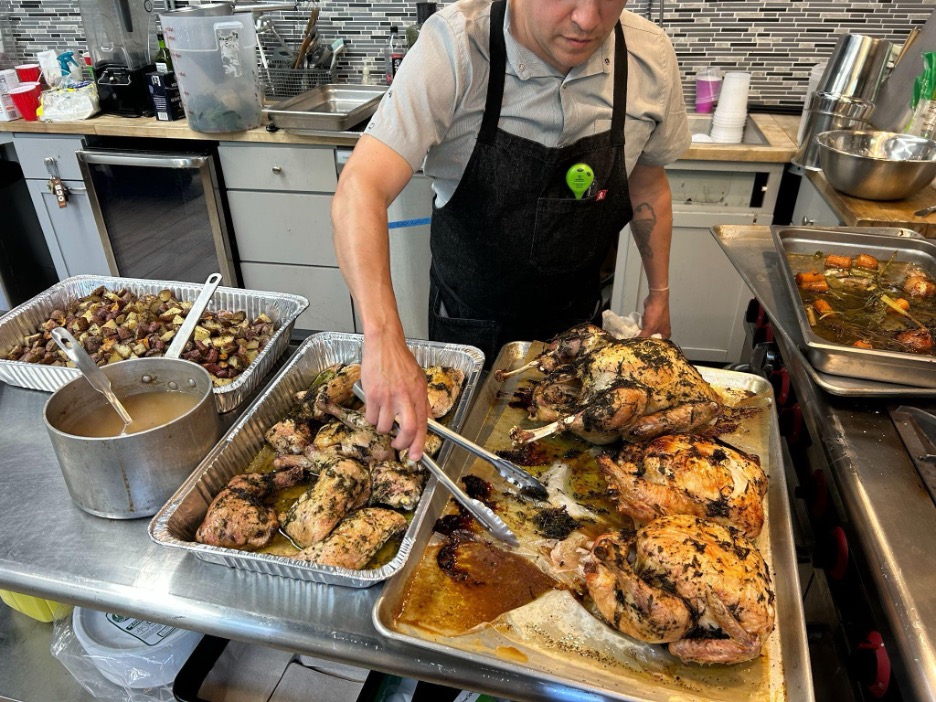
On the menu for a group of almost 20 elders were roasted chicken and turkey, collard greens, mushroom soup and roasted potatoes. Part of Molina’s work includes a weekly lunch for community elders. At every step, he prioritizes fresh, healthy ingredients — and does his best to avoid colonized foods whenever possible.
“Nope, I don’t use flour. We didn’t eat that before; our bodies know that,” Molina said.
Food as medicine is a guiding philosophy behind the growing Native food movement. The emphasis on eating whole foods connected to the local ecosystem is especially urgent as Native Americans experience the highest rates of diabetes of any demographic in the United States. In some communities, diabetes prevalence reaches as high as 60%. Government-provided rations to reservations historically included prepackaged meat such as Spam, lard, flour, butter and sugar. Reliance on these commodities continues to harm Native communities, as diabetes devastates families and reservations. The food-as-medicine movement allows chefs to restore health by reconnecting communities with their original foodways.
While the elders ate in a small room decorated with paintings of Indigenous hunters and flowing rivers, Molina prepared the dishes. Ronnie Preston (San Carlos Apache Nation), the program’s facilitator and cultural ambassador, stood at the front of the room.
“All right, everyone, listen up. It’s been a while, and I have a story for you,” Preston said. A storyteller at heart, he shared with the elders how a Native American tradition of ululation came to be.
Other elders contributed, sharing stories of hurtful stereotypes they had faced throughout their lives.
Preston described different Native foods he had tried. In Alaska, he talked about the savory taste of muktuk, or whale blubber, and shuddered at lamb-based dishes from the South. He even brought out a bag of piñon nuts, shells on, for everyone to try.
“In Arizona, this is like a bag of gold,” Preston said.
He explained no matter what he ate, food connected to his roots made him feel healthier than anything else.
“They say when you eat traditional foods that your ancestors did, there’s something in your body that awakens,” Preston said. “When I eat venison, I can feel my ancestors. It does something to my body.”
Similar to Defoe, it is hard for Molina to find “decolonized” ingredients, let alone food that isn’t genetically modified.
“I feel like in a city, it’s even harder to get produce, let alone the really nonprocessed, healthy stuff,” Molina said. He explained, just as his ancestors did before him, he finds ways to adjust around what’s available in an urban area. He said he had to teach himself everything about clean, healthy Native ingredients.
“It’s like we’re trying to go backward, but it’s hard. What do you do if those people are gone? It’s like you’re making your own history again,” he said.
Future of Native food
Back at Owamni, another Indigenous chef watches the line. It’s a shift change, a brief reprieve for the bustling kitchen. But a duck breast with a plum and sumac glaze was just fired, and Deryll Montana (Tohono O’Odham) jumps into action. He towers over most everyone in the kitchen, but the back of the house greets him with smiles.
“D in the house!” yells one of the bartenders.
Montana starts to prepare the glazed duck. The front and back of the house all smile as Montana appears. (Hailey Bosek/MEDILL)
Montana is a sous chef at Owamni but originally started on the line. Montana hasn’t been cooking for very long but says it was the work of other Indigenous chefs that inspired him to pick up the apron. Now, Montana is back with the Owamni team after helping lead the charge at a new Native Restaurant, the Frybread Lounge in Scottsdale, Arizona.
“This place has a really special place in my heart, with the team we’ve built and the food we are serving — this is home,” Montana said. “Without Sean and all the other Indigenous chefs, I wouldn’t be here.”
Every year, more Native American restaurants are opening, while others are closing.
Whatever the future of Native food holds, one thing is certain: Native chefs are not going back.
“The work is important,” Sherman said. “I’m just trying to change the way things were from when I grew up on the reservation.”
Montana is just one of many inspired by the growing movement.
“The future actually is happening now,” Montana said.
Help us defend tribal sovereignty.
At Native News Online, our mission is rooted in telling the stories that strengthen sovereignty and uplift Indigenous voices — not just at year’s end, but every single day.
Because of your generosity last year, we were able to keep our reporters on the ground in tribal communities, at national gatherings and in the halls of Congress — covering the issues that matter most to Indian Country: sovereignty, culture, education, health and economic opportunity.
That support sustained us through a tough year in 2025. Now, as we look to the year ahead, we need your help right now to ensure warrior journalism remains strong — reporting that defends tribal sovereignty, amplifies Native truth, and holds power accountable.
 The stakes couldn't be higher. Your support keeps Native voices heard, Native stories told and Native sovereignty defended.
Stand with Warrior Journalism today.
Levi Rickert (Potawatomi), Editor & Publisher