



- Details
- By Shaun Griswold
Staff at Owmani Restaurant were in Minneapolis prepping for the lunch crowd on January 7 when just three miles away, Renee Good was shot and killed by United States Immigration and Customs Enforcement (ICE) officer Jonathan Ross.
As the news spread across the city and out into the world, Owami owner Sean Sherman made the decision to close the restaurant.
“Our priority is the safety and well-being of our staff,” Sherman shared on social media. “We sincerely apologize for any inconvenience this may cause and deeply appreciate your understanding as we take care of our team. We truly could not do what we do without them.”
The Oglala Lakota Sioux chef cross-posted the message on Owamni’s official Instagram account, which has more than 71,000 followers, who shared mostly positive responses.
The next day, Sherman announced that Owamni would reopen and committed to donating ten percent of all sales from this past weekend directly to Good’s family.
“Sending support for her family during this time of grief feels like the right thing to do,” Sherman wrote in the Instagram post that has been liked by more than 10,000 people and shared by hundreds. “We hold Renee in our hearts and send love, strength, and calm to her family for their horrific loss. This is a heavy moment for Minneapolis. Please continue to show care for one another, move together and prioritize safety.”
Minneapolis remains under intense immigration enforcement from the nearly 2,000 federal officers that the U.S. Department of Homeland Security sent to the city last week to arrest the “worst of the worst.”
Since 2025, federal agents have reportedly arrested more than 1,000 people in Minneapolis. It’s unclear how many were arrested for immigration charges or alleged violent crimes like murder and sexual assault. On Jan. 6, one day before Good was killed, DHS announced 11 arrests in Minnesota with charges for violent crimes. In response to Good’s death, DHS has defended the use-of-force Ross took, and has announced more federal police will be sent in response to the demonstrations that have occurred in Minneapolis every night since she was killed.
Indigenous restaurants and businesses in Minneapolis, like Owamni, have responded with community support and resources to the chaos caused by the federal immigration enforcement operations, and have served as a support network for local Native Americans.
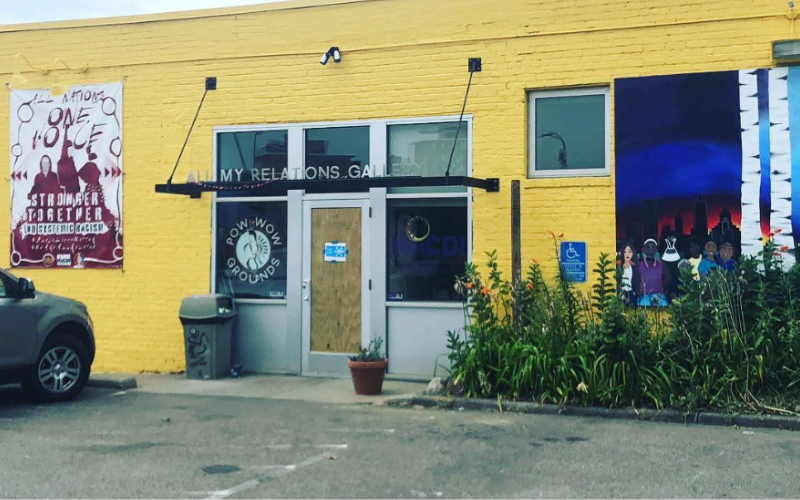
Over the weekend, Native-owned Pow Wow Grounds announced that it would serve as a “community headquarters for ICE patrol observation, rapid response coordination, and community support in South Minneapolis.”
The cafe, located off Franklin Avenue, shares space with the Native American Community Development Institute. The space hosts medical services, language classes, business development and other community events for Native Americans in the area.
Now, it’s central for information on Native people who are detained by ICE and a hub for anyone seeking relief from the federal police actions across the snowcapped city.
“This activation is a collaboration between Indigenous Protector Movement (IPM), Native American Community Development Institute (NACDI), and Powwow Grounds, coming together to support our relatives during ongoing ICE activity in our neighborhoods,” the collective wrote on its Instagram page. “We are mobilizing to ensure our community has a place to gather, organize, rest, and receive support. This space will serve as a staging area for observers, volunteers, and community members responding in real time.”
The collective does accept donations at Powwow Grounds.
Immediate Community Needs:
- Tobacco
- Monetary donations (to cover food and drinks on site)
- Blankets
- Snacks
- Water
- Whistles
- Coffee
- Air Mattresses
- Hand warmers
- Gas cards
- Toilet paper
- Firewood
Drop-Off & Volunteer Hours:
7:00 AM – 7:00 PM CST
Tribal Identification
Over the weekend, Pow Wow Grounds was the site for a pop-up event for the Mandan, Hidatsa and Arikara Nation located in South Dakota with a significant population in Minneapolis.
According to MPR, 40 MHA Nation citizens stopped by the coffee shop for information about their tribal identification.
Other tribal nations in the area are holding additional drop-in hours for people that need information on their tribal IDs. All have waived any processing fees.
“If you cannot be present physically, financial support is urgently needed to keep food, heat, and supplies available throughout the day,” Powwow Grounds shared on social media. “This activation is about keeping our community safe, supported, and connected during a time of fear and disruption. We protect each other.”
TRIBAL ID OFFICE HOURS
- Minneapolis Urban Office: Tuesday, Jan. 13, 1-6 p.m.
- Duluth Urban Office: Wednesday, Jan. 14, 1-6 p.m.
Additional dates:
- Minneapolis Urban Office: Tuesday, Feb. 3, 1-6 p.m.
- Duluth Urban Office: Wednesday, Feb. 4, 1-6 p.m.
- Leech Lake Twin Cities Office
- Tuesday, Jan. 13, 8 a.m. to 4:30 p.m.
- Wednesday, Jan. 14, 8 a.m. to 4:30 p.m.
- Mille Lacs Urban Office
- Monday through Friday, 8 a.m. to 4:30 p.m.
Red Lake Embassy Building
- Wednesday, Jan. 14, 9 a.m. to 4 p.m.
- Thursday, Jan. 15, 9 a.m. to 1 p.m.
- Minneapolis American Indian Center
Tuesday, Jan. 13, 9 a.m. to 4 p.m.
- Wednesday, Jan. 14, 9 a.m. to 12 p.m.
More Stories Like This
Native News Weekly (August 25, 2024): D.C. BriefsNative News Weekly (March 1, 2026): D.C. Briefs
Scope Narrowed, Report Withheld: Questions Mount Over Michigan Boarding School Study
Zuni Youth Enrichment Project Announces Family Engagement Night and Spring Break Youth Programming
Next on Native Bidaské: Leonard Peltier Reflects on His First Year After Prison
Help us defend tribal sovereignty.
At Native News Online, our mission is rooted in telling the stories that strengthen sovereignty and uplift Indigenous voices — not just at year’s end, but every single day.
Because of your generosity last year, we were able to keep our reporters on the ground in tribal communities, at national gatherings and in the halls of Congress — covering the issues that matter most to Indian Country: sovereignty, culture, education, health and economic opportunity.
That support sustained us through a tough year in 2025. Now, as we look to the year ahead, we need your help right now to ensure warrior journalism remains strong — reporting that defends tribal sovereignty, amplifies Native truth, and holds power accountable.
 The stakes couldn't be higher. Your support keeps Native voices heard, Native stories told and Native sovereignty defended.
Stand with Warrior Journalism today.
Levi Rickert (Potawatomi), Editor & Publisher