- Details
- By Levi Rickert
A Michigan House General Government Subcommittee hearing was held Thursday morning to determine why the Native American Boarding Schools in Michigan Final Report has yet to be officially released by the State of Michigan.
Chaired by Rep. Tom Kuhn (R-Troy), the hearing was marked by sharp finger-pointing over the horrific legacy of Indian boarding schools — an era that left generations of Native Americans suffering from historical trauma caused by physical, emotional, and sexual abuse, including rape and the disappearance of Native children.
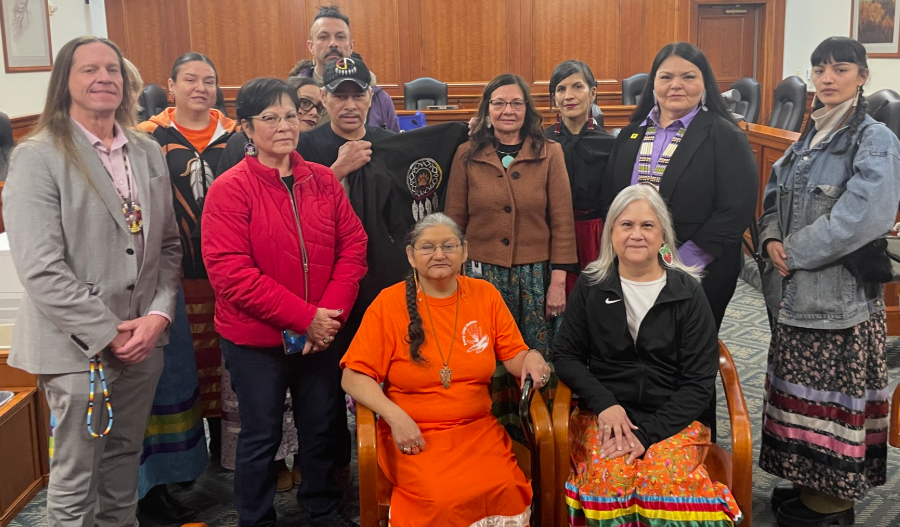
Nearly 20 Native Americans from across Michigan attended, filling the audience seating.
During the 90-minute hearing, lawmakers heard testimony from representatives of the contracted firm, Kauffman and Associates, Inc. (KAI) — a 36-year-old, Spokane, Washington–based Native- and woman-owned company that researched and authored the 301-page report at a cost of $1.1 million — as well as from three Michigan tribal leaders and an Indian boarding school survivor.
The initiative began in 2019 when Michigan Gov. Gretchen Whitmer, at the request of several tribal leaders, issued an executive directive to investigate Indian boarding schools in the state. The effort was later funded by the Michigan Legislature.
“It is unacceptable for the state to ignore its own directive, mishandle a contract, and then threaten lawsuits over an outcome the state itself largely caused,” Kuhn said. “Taxpayers deserve accountability, and our tribal partners deserve honesty and respect.”
Notably absent were in-person representatives from the Michigan Attorney General’s Office and the Michigan Department of Civil Rights (MDCR). The MDCR submitted written testimony that placed blame elsewhere for the report’s continued withholding from the public.
Jo Ann Kauffman (Nez Perce Tribe), founder of KAI, defended the work behind the initiative and detailed the methodology, which identified more than 30 boarding school sites in Michigan and documented widespread abuse and cultural erasure. She testified that the study encountered challenges, including conflicting directives from the MDCR and the Attorney General’s Office.
During the contract period, MDCR changed the staff overseeing the project. Around the same time, the Attorney General’s Office became involved and issued directives that Kauffman said were inconsistent with the contract’s scope.
“The change in MDCR staffing was accompanied also by the inclusion of representatives from the Attorney General's Office (AG), and from this point on, the AG representatives led the project calls and provided substantive direction to KAI, and one AG representative gave new directives to KAI to significantly shift and narrow the scope of our study,” Kauffman said.
“In our report, we were asked for deletion of references to Native children being sent out of state and asked to delete references to counties and county entities in the state of Michigan, except when it was directly quoted by a participant — [which] ran counter to the stated goals of the project and to the trust extended to the researchers by survivors, descendants and tribal partners,” Kauffman continued.
Rep. Will Snyder (D-Muskegon) appeared to defend the Attorney General’s Office, pointing to the report’s lack of sourcing and citations for its legal theories, as well as the absence of an independent review board similar to those typically used in university-led studies.
He also raised concerns about footage included in a promotional trailer in the fall of 2024. In response, Kauffman and Dr. Chesleigh Keene, KAI’s vice president for research and evaluation, said that after viewing the recording from a tribal consultation meeting, one individual chose to withdraw her consent.
“Not only did we honor the request from the tribal member at the consultation, we extended a reconsenting process to all participants in the video testimony, and so in confirming those consent, what we have now are only participants who verified their consent after consultation,” Keene said.
The participant referenced was Winnay Wemigwase, tribal chairperson of the Little Traverse Bay Bands of Odawa Indians, who attended and testified at the hearing.
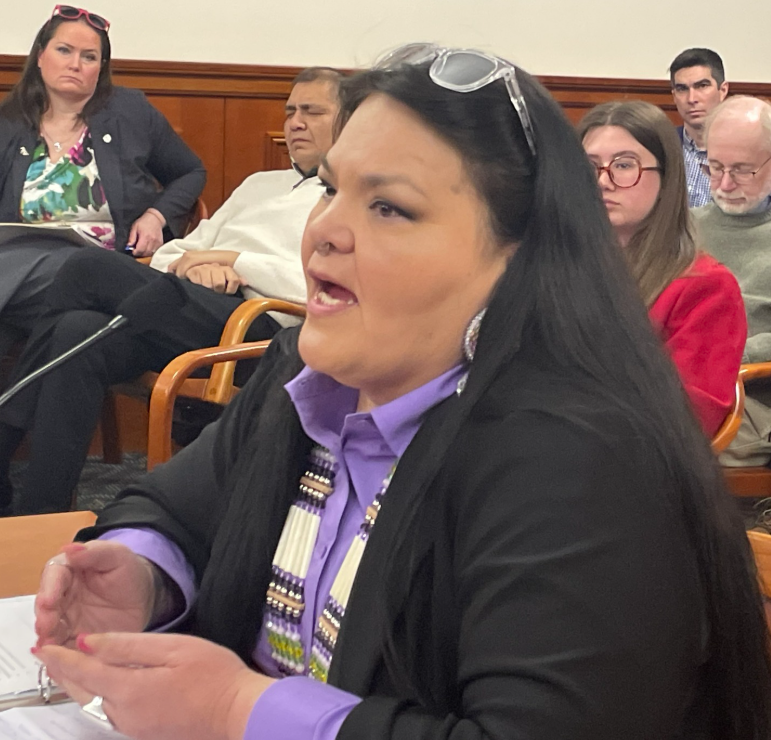
Winnay Wemigwase, tribal chairperson of the Little Traverse Bay Bands of Odawa Indians, made testimony. (Photo/Levi Rickert)
Wemigwase, who atteneded the Holy Childhood of Jesus Indian Boarding School in Harbor Springs, Mich., said she was initially reluctant to testify but agreed to an interview lasting nearly two hours. She signed a consent form but said she did not realize a portion of her interview would be used in a promotional trailer that was never publicly released. However, the footage was shown to tribal leaders during a consultation session at the Little River Band of Ottawa Indians in Manistee.
She testified that she withdrew her consent because she felt it was unfair for a brief excerpt of her two-hour interview to be used in a short promotional clip.
“Knowing that I now have a responsibility to my community, because part of my job is to protect them, I wondered how many other people did this happen to?” Wemigwase testified. “And so even in that short video, I knew every single one of those people that ran the video. And yeah, they probably signed a consent form too, and maybe they're okay with what was put in there, but maybe they are not.”
Grand Traverse Band of Ottawa and Chippewa Indians Chairwoman Sandra Witherspoon testified remotely. She said the GTB fully understands the trauma Native students endured in Indian boarding schools. She argued the state should not keep the KAI report sealed, but that interview participants should be allowed to withdraw consent if they choose. However, she emphasized that work on the issue must continue.
“GTB seeks a constructive and functional path forward that promotes cooperation between tribal and non-tribal governments, and, more significantly, redress for survivors and descendants who have suffered. GTB supports the state of Michigan's continued funding for research into and public access to the history of Michigan Indian boarding schools. Such efforts promote accountability, truth telling and healing,” Witherspoon testified.
Rodney Loonsfoot, a member of the Keweenaw Bay Indian Community Tribal Council and an Indian boarding school survivor, was the final tribal leader to testify.
“I want to acknowledge that Kauffman and Associates assembled an outstanding professional scholarly team, which included many proud tribal Indigenous people to help and guide this work. That matters, because that is where you start to build that trust. In doing this, they were asked, essentially, to compress decades of trauma, lost records, force removals and cultural destruction into a short report — and to do so while many of the original files remain inaccessible or missing entirely. This is not a criticism of the effort; it is the recognition of the limitations,” Loonsfoot testified.
Sharon Skutt (Saginaw Chippewa Indian Tribe of Michigan), who attended the Holy Childhood of Jesus Indian Boarding School from 1967 - 1970, gave the last testimony of the day. She said she is a third generation Indian boarding school survivor.
She testified that she could not talk about her Indian boarding school exeperiences for decades.
"It took me almost 55 years before I could speak about it, and at this point, I'm 69. I realized at 65, I needed to speak about these things, because if we don't speak now, no one will know what happened at the boarding school."
More Stories Like This
Native News Weekly (August 25, 2024): D.C. BriefsZuni Youth Enrichment Project Announces Family Engagement Night and Spring Break Youth Programming
Next on Native Bidaské: Leonard Peltier Reflects on His First Year After Prison
Deb Haaland Rolls Out Affordability Agenda in Albuquerque
Help us defend tribal sovereignty.
At Native News Online, our mission is rooted in telling the stories that strengthen sovereignty and uplift Indigenous voices — not just at year’s end, but every single day.
Because of your generosity last year, we were able to keep our reporters on the ground in tribal communities, at national gatherings and in the halls of Congress — covering the issues that matter most to Indian Country: sovereignty, culture, education, health and economic opportunity.
That support sustained us through a tough year in 2025. Now, as we look to the year ahead, we need your help right now to ensure warrior journalism remains strong — reporting that defends tribal sovereignty, amplifies Native truth, and holds power accountable.
 The stakes couldn't be higher. Your support keeps Native voices heard, Native stories told and Native sovereignty defended.
Stand with Warrior Journalism today.
Levi Rickert (Potawatomi), Editor & Publisher