



- Details
- By Shaun Griswold
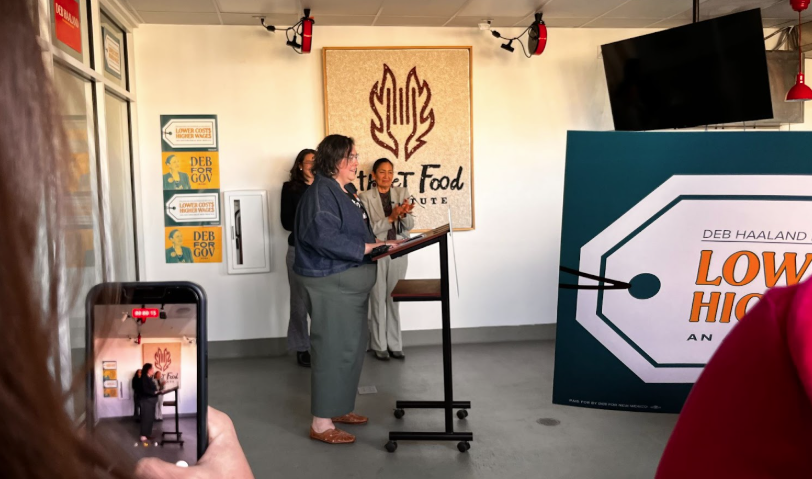
Native Vote 2026. ALBUQUERQUE, N.M. — Floor-to-ceiling windows separated two Albuquerque community kitchens inside the Street Food Institute. In one kitchen, New Mexico candidate for governor Deb Haaland (Laguna Pueblo) outlined an affordability plan she said would support the people who worked in the kitchen across the hall, where silver trays clanked during afternoon cleanup as she spoke on Wednesday.
Haaland stressed the importance of food and housing costs in her affordability platform for New Mexicans.
“It’s expensive to be poor,” Haaland said before following with proposals to increase the state’s minimum wage to $14.50 from the current $12 per hour rate, expand its child tax credit, create investments in renewable energy, ban rental price fixing and predatory lending, and increase available housing through reforms in short-term rental and building development policies.
“We heard from a lot of people who say the permitting process is entirely too long. It takes such a long time to get permits to build,” she said. “Developers or folks who are building affordable housing will just go to another state because they can't wait any longer.”
It’s the second major policy rollout for Haaland in her run to become the country’s first female Native American governor, and one rooted in her personal experience that she has shared since the Laguna Pueblo woman entered public service. Her opponent in the state’s Democratic primary, Sam Bregman, has similar affordability proposals in his pitch to New Mexico voters.
At the event, Haaland described the salsa business she started out of a small kitchen to cover health care costs for her daughter. She would drive hundreds of miles to Northern New Mexico to procure 50-pound bags of dried red chile she needed as the main ingredient for her recipe, which she would jar and then sell at markets out of her car.
“It was important that I used local farmers for that purpose. I think there are a lot of local farmers here who would grow things according to what communities need,” she said. “There's not a grocery store in this neighborhood, and so that's the reason why (The Street Food Institute) started. They want to have a little storefront so that people can actually get fresh vegetables in this community.”
The Street Food Institute was an appropriate setting as an example of the type of small business programs Haaland’s plan would support. There, the local nonprofit teaches college students and community members two courses in food entrepreneurial management and food safety certification, along with support to establish a small business with things like licenses and permits. The goal is to build a network of small businesses that meet community food needs.
“There are food deserts across New Mexico,” Haaland said. “That's a sad fact, and there are food deserts very near to cities. So we have to remember that not everyone has a car. Transportation is an issue also for folks and why they may not be able to get to a grocery store.”
Ivydel Natachu moved to Albuquerque from Zuni Pueblo for better access to cancer treatment. After Haaland spoke, she approached the candidate for a brief conversation and selfie. Natachu said she’s grateful Zuni has two small grocery stores in the Pueblo, but families still need help with food deliveries from larger grocery stores in nearby border towns. It’s to the point, she said, that community members have taught elders in Zuni how to order food from the Walmart or Safeway app, then have someone with a car deliver the groceries.
“Tuesdays and Thursdays, they're going to Gallup with these people, and they take orders and then they go to those stores, pick up the orders, and then they deliver them. So that's another new thing going on,” Natachu said. “I'm glad that person is teaching the elders how to use them.”
Haaland’s affordability plan has specific carve-outs to expand self-determination for tribal governments in New Mexico.
She said one way that would happen is by creating the state’s version of the Native American Business Incubators Program Act, which she passed while in Congress and which was signed by President Donald Trump.
“I got five bills passed and signed into law by President Trump, and so I think that shows how well I can work across the aisle and how even Donald Trump thinks I have good ideas,” Haaland quipped.
Federal funding ended for that program, and Haaland’s approach to enact it locally would include state funding that would allow tribes to spend the money as they see fit.
“Tribes employ a lot of New Mexicans. They aren't always tribal members,” Haaland said pointedly. “And so paying attention to the tribal economies across our state, I think, will benefit New Mexico an incredible amount.”
More Stories Like This
Native News Weekly (August 25, 2024): D.C. BriefsBoys & Girls Clubs and BIE MOU Signing at National Days of Advocacy
National Congress of American Indians Mourns the Passing of Former Executive Director JoAnn K. Chase
Navajo Nation Mourns the Passing of Former Vice President Rex Lee Jim
Help us defend tribal sovereignty.
At Native News Online, our mission is rooted in telling the stories that strengthen sovereignty and uplift Indigenous voices — not just at year’s end, but every single day.
Because of your generosity last year, we were able to keep our reporters on the ground in tribal communities, at national gatherings and in the halls of Congress — covering the issues that matter most to Indian Country: sovereignty, culture, education, health and economic opportunity.
That support sustained us through a tough year in 2025. Now, as we look to the year ahead, we need your help right now to ensure warrior journalism remains strong — reporting that defends tribal sovereignty, amplifies Native truth, and holds power accountable.
 The stakes couldn't be higher. Your support keeps Native voices heard, Native stories told and Native sovereignty defended.
Stand with Warrior Journalism today.
Levi Rickert (Potawatomi), Editor & Publisher