- Details
- By Native News Online Staff
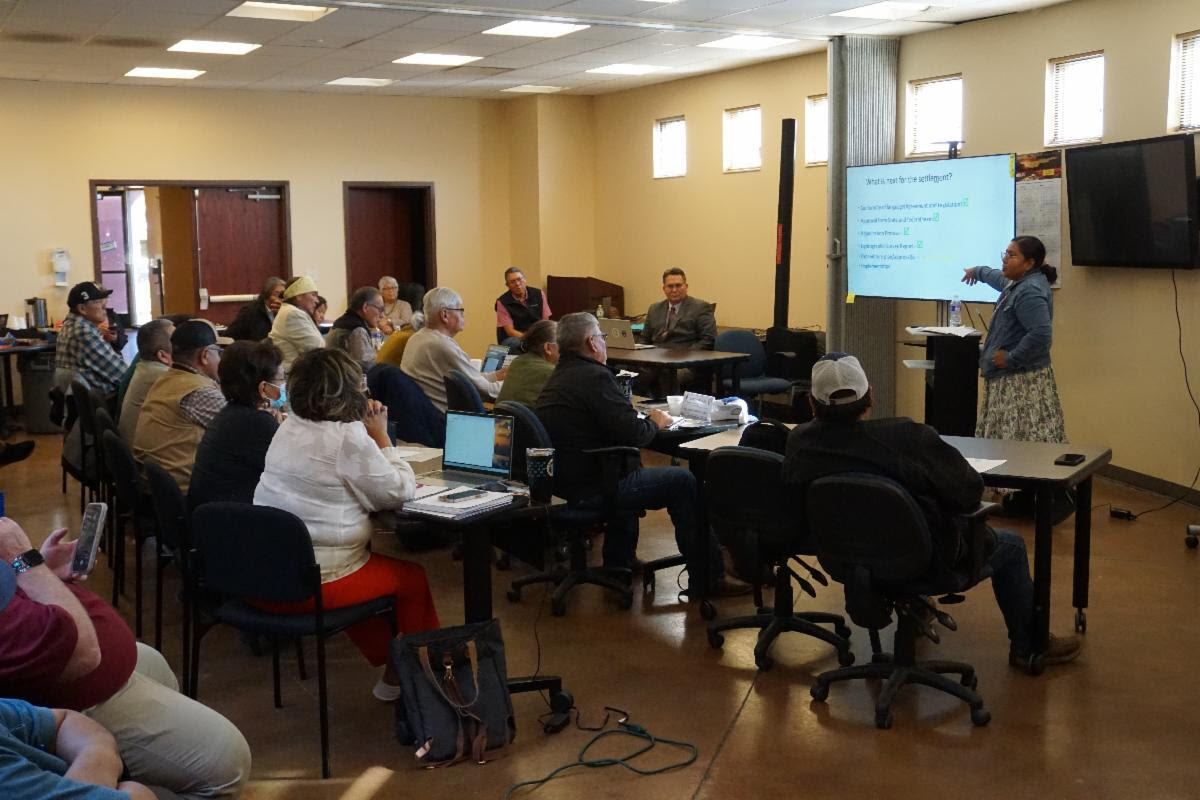
The Navajo Utah Commission met Tuesday to address water access challenges and infrastructure planning for Navajo communities in Utah, focusing on a comprehensive white paper, implementation of the Utah Navajo water decree and budget priorities tied to long-term planning under the Navajo Utah Water Rights Settlement Act.
Members reviewed progress on a white paper that consolidates technical findings, legal considerations and community priorities related to water rights, infrastructure gaps and implementation timelines. The document is intended to guide coordination with federal, state and local partners while providing Navajo chapters with a planning framework as settlement activities advance.
“The document is designed to guide coordination with federal, state, and local partners while giving Navajo chapters a clear planning framework as settlement activities advance,” said Council Delegate Curtis Yanito, who represents Mexican Water, To’likan, Teesnospos, Aneth and Red Mesa. “Updated estimates reflect approximately $210 million in overall needs, including about $183 million dedicated to water infrastructure such as treatment facilities, transmission lines, storage, and related systems.”
The Navajo Nation Legal and Technical Team — including the Department of Justice Water Rights Unit, Department of Water Resources and Water Rights Commission — reported that the planning effort supports implementation of the Utah Navajo water decree. The decree secures 81,500 acre-feet of water for Navajo communities in Utah and establishes a legal framework for developing, operating and maintaining water infrastructure.
Commission members said translating the decree into on-the-ground improvements will require careful project sequencing, accurate cost estimates and sustained funding across multiple phases. They emphasized the need for a formal fund management and expenditure plan to ensure transparency, fiscal accountability and chapter-level input before settlement funds are allocated.
Members also reviewed proposed budget figures covering planning, design and early implementation, including engineering assessments, hydrographic surveys, project management and coordination with existing water and utility systems. Presenters said the scalable budget framework allows future appropriations to align with project readiness, construction cost inflation and evolving community needs, while accounting for long-term operation, maintenance and replacement costs.
Yanito said the commission’s approach emphasizes clarity, accountability and community engagement, with the white paper serving as a roadmap connecting legal outcomes of the water decree to community-level implementation.
Council Delegate Herman Daniels Jr., who represents Tsah Bii Kin, Navajo Mountain, Shonto and Oljato, stressed the importance of proactive planning supported by realistic budget projections.
“Aligning water allocations with a structured, long-term plan strengthens the Navajo Nation’s position with state and federal partners and helps ensure recognized water rights result in reliable, functional infrastructure,” Daniels said.
Commission members supported integrating policy analysis, legal implementation and detailed budget planning as a key step toward addressing long-standing infrastructure inequities in Utah Navajo communities.
The commission also discussed establishing a public outreach plan under the settlement, including Diné bizaad interpretation, chapter-level presentations and accessible materials to help communities understand the agreement and proposed projects.
The Navajo Utah Commission will continue refining the white paper, coordinating with technical experts and utility partners, and advancing budget and fund management discussions as part of its mandate to advocate for long-term water solutions in Utah Navajo communities.
More Stories Like This
Native News Weekly (August 25, 2024): D.C. BriefsNative News Weekly (March 1, 2026): D.C. Briefs
Scope Narrowed, Report Withheld: Questions Mount Over Michigan Boarding School Study
Zuni Youth Enrichment Project Announces Family Engagement Night and Spring Break Youth Programming
Next on Native Bidaské: Leonard Peltier Reflects on His First Year After Prison
Help us defend tribal sovereignty.
At Native News Online, our mission is rooted in telling the stories that strengthen sovereignty and uplift Indigenous voices — not just at year’s end, but every single day.
Because of your generosity last year, we were able to keep our reporters on the ground in tribal communities, at national gatherings and in the halls of Congress — covering the issues that matter most to Indian Country: sovereignty, culture, education, health and economic opportunity.
That support sustained us through a tough year in 2025. Now, as we look to the year ahead, we need your help right now to ensure warrior journalism remains strong — reporting that defends tribal sovereignty, amplifies Native truth, and holds power accountable.
 The stakes couldn't be higher. Your support keeps Native voices heard, Native stories told and Native sovereignty defended.
Stand with Warrior Journalism today.
Levi Rickert (Potawatomi), Editor & Publisher