- Details
- By Elyse Wild
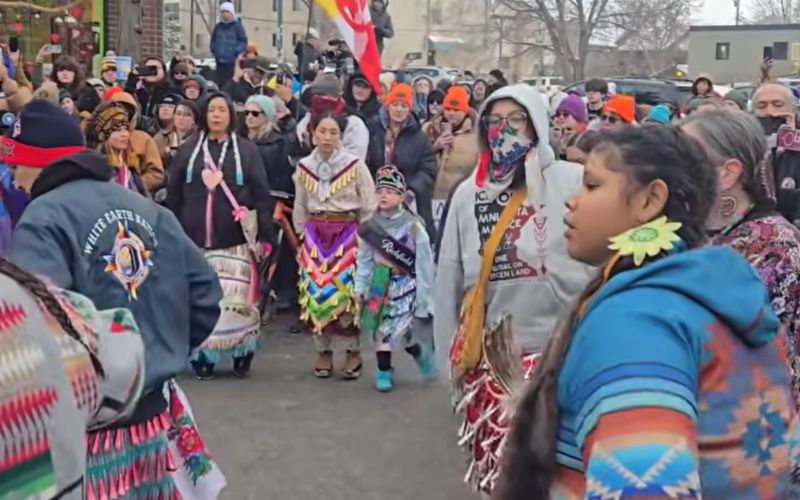
Earlier this month, an intersection in south Minneapolis was filled with the rhythmic sound of jingle dresses. Bright garments adorned with thousands of pieces of curled tin sang when knocked against each other, to the movement of the Ojibwe women who danced in ceremony to honor the lives of Renee Good and Alex Perretti, two U.S. citizens killed in the city by militant agents of the U.S. Immigration and Customs Enforcement (ICE) in January.
The ceremony is emblematic of the Native American community’s response to the violent federal immigration campaign that has brought widespread fear, turmoil, and grief since the ICE descended on the Twin Cities and remains even with a drawback of federal police operations in Minnesota. Among the dancers was Tracey Strong Dagen (Bois Forte). Dagen talked to Native News Online about growing up in a family of jingle dress dancers, answering the call to ceremony, and healing from violence through dance.
Native News Online: When did you start dancing, and what is your personal history with it?
Tracy Strong Dagen: I grew up in a family of jingle dress dancers. I can’t remember not being in a circle. We were always proud jingle dress dancers. I made all my family’s beadwork — beaded a few different things for each kid. I helped with my mom’s regalia, my aunties’ regalia, my nieces and nephews. I don’t sew, and I don’t bead anymore, but I used to do most of the beadwork and my sisters and mother would do the sewing part.
NNO: What does jingle dancing mean to you personally? How does it feel when you’re dancing?
Strong Dagen: We were always taught that the jingle dress helps you heal. Use it in a good way, and you’re going to be good.
NNO: How did you come to jingle dance in honor of Alex Peretti and Renee Good in Minneapolis?
Strong Dagen: Someone put out the call for jingle dress dancers. My friend and I said, “Yeah, we’ll go down for the healing ceremony. No problem.” I have a daughter who lives in the city, so I’m down there once a month anyway.
You can’t just sit there. Being complacent is acceptance, and I’m not one to just let it go. It was hard to see those videos and know what’s happening in your neighborhood. My nephew was pretty close with Alex and his wife — he is helping Alex’s family move out to a safer place. Both Alex and Rene were water protectors for Line 3.
NNO: We’ve seen a lot of ways people are coming together—the jingle dancing, drummers, and even a brass band playing. What has that been like to witness?
Strong Dagen: Minneapolis deserves a Nobel Peace Prize, honestly — how everybody came together, still coming together, protecting their neighborhoods, protecting their neighbors, making sure their neighbors are okay.
NNO: All eyes are on Minneapolis and, particularly the Native community right now. What do you hope the world takes away from the jingle dancing — what do you hope people say about it ten years from now?
Strong Dagen: The healing. Just doing the dance is healing for me. When we came over that hill at Powderhorn, there were already 3,000 people in that park. It was healing for me to be out there.
NNO: Is there anything else you want people to know?
Strong Dagen: Just come together in unity. Come together, help each other, help your neighbor. We’re all in this together. We can heal. We can heal together.
More Stories Like This
Native News Weekly (August 25, 2024): D.C. BriefsHaaland Gets First Hand Look at Efforts to Address Homelessness in Albuquerque
Navajo Nation Secures $285 Million in Federal Broadband Funding to Connect Thousands of Homes
Oral History Project Announces 18th Stop in Denver, Colorado: NABS Continues Preserving Critical Stories Across Indian Countr
Help us defend tribal sovereignty.
At Native News Online, our mission is rooted in telling the stories that strengthen sovereignty and uplift Indigenous voices — not just at year’s end, but every single day.
Because of your generosity last year, we were able to keep our reporters on the ground in tribal communities, at national gatherings and in the halls of Congress — covering the issues that matter most to Indian Country: sovereignty, culture, education, health and economic opportunity.
That support sustained us through a tough year in 2025. Now, as we look to the year ahead, we need your help right now to ensure warrior journalism remains strong — reporting that defends tribal sovereignty, amplifies Native truth, and holds power accountable.
 The stakes couldn't be higher. Your support keeps Native voices heard, Native stories told and Native sovereignty defended.
Stand with Warrior Journalism today.
Levi Rickert (Potawatomi), Editor & Publisher