- Details
- By Elyse Wild
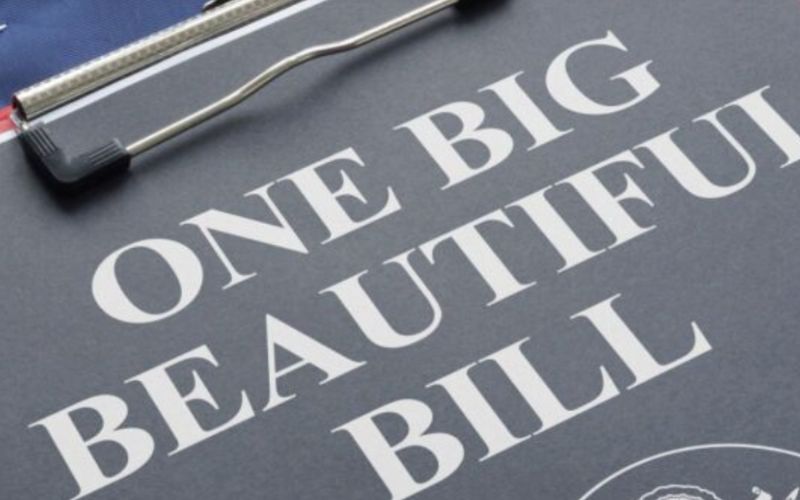
President Trump’s massive spending bill, signed into law last July, strips Tribes of billions in clean energy spending and could potentially have devastating effects on Native communities’ access to healthcare and food assistance. That’s according to a new report from the Brookings Institution examining the “One Big, Beautiful Bill Act,” (OBBBA) and its potential influence on clean energy, Medicaid, and food programs in Indian Country.
Trump increased federal spending by $328 billion when Congress passed the “One Big, Beautiful Act” in 2025. The package paid for Trump’s policies on national security — giving the Department of Homeland Security its largest budget ever — expanded tax breaks for Americans, and steered Day 1 energy priorities.
Energy policies are where the economic fallout hit most for Indian Country, according to the Brookings report released today.
Trump’s spending bill eviscerated $433 billion for programs authorized by Congress in 2022 through the Inflation Reduction Act, which offered Indian Country funding opportunities for programs to address clean energy, community resilience, housing, and infrastructure. Now, federal programs that were allocated billions for Indian Country are defunct.
“The (One Big, Beautiful Act’s) program cuts represent a rejection of the binding fiduciary responsibility that the federal government has to Indian Country to ensure them the same quality of life as the non-Native population across health, infrastructure, economic vitality, and environmental safety,” the report states.
According to a 2024 report from the Department of the Interior, the IRA would have poured $4.2 billion into Indian Country.
The Brookings report identified more than $2 billion from the IRA had already been paid out to tribes through grants, direct payments or cooperative agreements. The three largest funding sources hit hardest by Trump — Greenhouse Gas Reduction Fund, Greenhouse Gas Pollution Grant Program, and Environmental and Climate Justice Block Grants—would have provided $1.3 billion of total Tribal IRA funding. All three were eliminated by the OBBBA.
Tribes faced cancelled grants for ongoing projects, and have been forced to seek funding through court injunctions and additional sources.
“The Trump administration’s rationale for cancelling the above IRA programs is based on “unleashing American energy dominance” by ‘rescinding billions in green corporate welfare,’ ‘restoring consumer choice,’ and ‘driving down prices for families.’ Yet the cancellations ignore the increased need that has arisen in Native communities on and off reservations as a direct result of federal disinvestment and resource extraction,” the report states.
Treaty Violations and Healthy Communities
The Brookings report underscores that the potential fallout from the OBBBA is symptomatic of the federal government's reliance on discretionary funding and grants to support Tribes. The result, the report argues, pits tribes against non-Native entities for funding of essential services and amounts to violations of the U.S. trust and treaty obligations to provide health care, nutrition assistance, and environmental support to Tribal nations.
In the spending bill, Trump championed an expansion of work requirements for people who receive Medicaid and food aid from the Supplemental Nutrition Assistance Program (SNAP).
The law requires that individuals without dependent children must work at least 80 hours per month to receive those benefits. Native American people are exempt from these requirements; however, the Brookings report found there is no clear process for states to verify tribal enrollment to ensure an individual qualifies for the exemption. The lack of clarity can result in disenrollment of Native people from these programs that disproportionately serve Indian Country.
Loss of SNAP benefits could exacerbate the already inadequate food access in many Native communities. Native people experience the highest levels of food insecurity of any demographic in the United States, and 23% benefit from SNAP — nearly double the national average, according to the Economic Policy Institute.
As well, the potential fallout of Medicaid disenrollment of Native people could have dire consequences in Tribal communities that already bear the highest rates of chronic illness while contending with limited access to healthcare.
Medicaid is a critical component of the hodgepodge of programs that prop up the Indian Health Service (IHS). The agency is tasked with providing healthcare for more than 2.6 million Native people across the United States, but has long suffered from inadequate budgets and staffing vacancies. Medicaid accounts for 30-60% of overall funding at many IHS facilities. In 2025, the IHS billed approximately $1.3 billion to Medicaid. The health coverage is also crucial for Native people who need specialized care beyond what their IHS hospital can provide.
The OBBBA requires states to use existing databases to automatically verify exempt status for the work requirements. Only about half of all states consistently capture race and ethnicity data on the majority of Medicaid applications, and, as of 2023, only eight states share Medicaid data with tribal governments.
Individuals who can’t be verified from existing documentation may need to submit manual documentation of their enrollment status, presenting a barrier for Native people living on reservations who lack access to a mailing address and reliable Internet.
The report draws upon Arkansas as an example of the discrepancies. In 2018, the state passed minimum Medicaid work requirements, with a similar exception for Native people. Existing records were used to identify those who were exempt — 75% of those who couldn’t be automatically verified were disenrolled from health coverage.
More Stories Like This
Native News Weekly (August 25, 2024): D.C. BriefsUS Presidents in Their Own Words Concerning American Indians
Native CDFI Leaders Push for More Funding
Interior Department Launches Program to Train Native Youth for Wildland Firefighting
Help us defend tribal sovereignty.
At Native News Online, our mission is rooted in telling the stories that strengthen sovereignty and uplift Indigenous voices — not just at year’s end, but every single day.
Because of your generosity last year, we were able to keep our reporters on the ground in tribal communities, at national gatherings and in the halls of Congress — covering the issues that matter most to Indian Country: sovereignty, culture, education, health and economic opportunity.
That support sustained us through a tough year in 2025. Now, as we look to the year ahead, we need your help right now to ensure warrior journalism remains strong — reporting that defends tribal sovereignty, amplifies Native truth, and holds power accountable.
 The stakes couldn't be higher. Your support keeps Native voices heard, Native stories told and Native sovereignty defended.
Stand with Warrior Journalism today.
Levi Rickert (Potawatomi), Editor & Publisher