- Details
- By Levi Rickert
Opinion. There is considerable attention surrounding the yet-to-be-officially released Native American Boarding Schools in Michigan Final Report. In particular, there is an emphasis on the $1.1 million in Michigan taxpayer dollars spent on the report — and the state’s decision not to release it.
The attention is misplaced. Instead of being concerned about the money, perhaps the focus should be on what really happened to Native children in those boarding schools.
But if the emphasis is on money spent, a reset is appropriate — and it requires context about revenue paid to the state and local governments under tribal-state gaming compacts.
Back in the late 1990s, approximately $55 million in tribal gaming revenue was allocated by the state of Michigan to help finance the land acquisition and infrastructure costs for the construction of Comerica Park, home of the Detroit Tigers, which opened in 2000. These funds were drawn from the Michigan Strategic Fund — a fund supported largely by revenue generated by tribally-operated casinos.
Fast forward to 2024: Michigan’s tribes collectively paid $30.5 million to local revenue-sharing boards and nearly $39 million to the state under compact agreements — a combined total approaching $70 million. These payments stem from negotiated tribal-state compacts under the Indian Gaming Regulatory Act.
Since the introduction of Indian gaming, tribes in Michigan have paid hundreds of millions of dollars to the state. Those payments reflect negotiated agreements between sovereign governments, not charity.
That’s why, in 2019, a group of Michigan tribal leaders approached Gov. Gretchen Whitmer to request a study of Indian boarding schools in Michigan. This was before former Interior Secretary Deb Haaland (Laguna Pueblo) launched the Federal Indian Boarding School Initiative, led by Assistant Secretary for Indian Affairs Bryan Newland, former tribal chairperson of the Bay Mills Indian Community in Brimley.
It took until 2022 for the Michigan Legislature—with Gov. Whitmer’s blessing—to approve $1.25 million to research Michigan’s Indian boarding schools.
Beyond the federal initiative, a small number of states have launched their own examinations of boarding school history. Colorado released a report in 2023. Washington established a commission. Michigan now finds itself stalled.
Michigan’s process appears flawed — mired in finger-pointing and locked in an impasse, with a final report that has yet to be officially released.
The Michigan Department of Civil Rights and the state’s attorney general’s office have not released the report because they called the work of their contracted firm, Kauffman & Associates, Inc., a Spokane, Wash.-based Native- and woman-owned firm, insufficient. The department called some parts of the work “shoddy.”
Kauffman & Associates has called the suppression of the report “whitewashing” of what happened in Indian boarding schools in Michigan.
On Thursday, the Michigan House General Government Subcommittee, chaired by Rep. Tom Kuhn (R-Troy), held a hearing to determine why the report remains withheld.
The hearing was marked by sharp exchanges over the horrific legacy of Indian boarding schools — an era that left generations of Native Americans with historical trauma rooted in physical, emotional, and sexual abuse, including rape and the disappearance of Native children.
Notably absent from Thursday’s hearing were in-person representatives from the Michigan Department of Civil Rights and the attorney general’s office. The department submitted written testimony, shifting blame elsewhere for the report’s continued withholding.
Kauffman & Associates was represented virtually by founder Jo Ann Kauffman (Nez Perce). She defended the integrity of the work and outlined a methodology that identified more than 30 boarding school sites in Michigan, documenting abuse and cultural erasure.
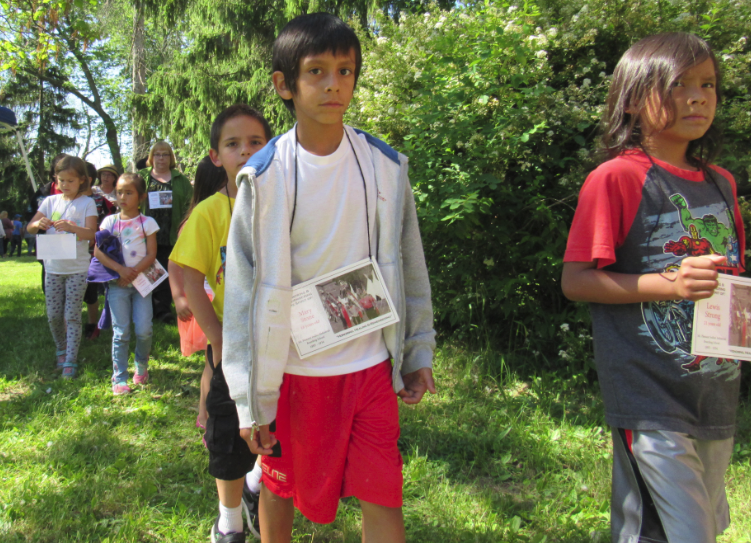
"Honoring, Healing & Remembering" event on grounds of closed Mt. Pleasant Indian Industrial Boarding School in Mt. Pleasant, Mich. on June 7, 2018. (Photo/Levi Rickert)
She also described obstacles, including conflicting directives from the Department of Civil Rights and the attorney general’s office.
During the contract period, MDCR changed the staff overseeing the project. Around the same time, the attorney general’s office inserted itself into the process, issuing directives that Kauffman said were inconsistent with the contract’s scope.
“The change in MDCR staffing was accompanied by the inclusion of representatives from the attorney general's office,” Kauffman testified. “From that point on, the AG representatives led the project calls and provided substantive direction to (our firm), and one AG representative gave new directives to significantly shift and narrow the scope of our study.”
There was also testimony from a tribal leader who became upset after a portion of her interview appeared in a promotional video trailer. After viewing the clip, she withdrew her consent. Kauffman & Associates and the Department of Civil Rights removed the footage. The trailer was never released publicly.
That incident now appears to be part of the state’s justification for withholding the report. Additionally, some of Michigan’s tribal leaders have asked that the report not be released publicly.
Here is the larger truth: Michigan owes better. It owes transparency. It owes accountability.
Money already spent should not halt the pursuit of truth. Over three decades, Michigan has received hundreds of millions of dollars through tribal compacts. Against that record, $1.1 million is not the issue. The issue is whether the process is credible and led by the people most affected by its findings.
If the current report cannot withstand scrutiny, then the state should fix the process — transparently and with Native leadership at its center. That may mean revising the report. It may mean commissioning new work. But it must mean restoring trust.
Accountability requires Native authority over how this history is examined, documented and shared.
Michigan cannot undo what happened in its boarding schools. But it can decide whether to face that history honestly.
Thayék gde nwéndëmen — We are all related.
More Stories Like This
Building a Stronger Nation Through ServiceIs Oil Worth More Than Water?
Tribal Economic Development Programs in the Federal Contracting Environment: What They Are, and What They Are Not
Why Redefining Public Health Degrees Would Harm Native and Rural Communities
Help us defend tribal sovereignty.
At Native News Online, our mission is rooted in telling the stories that strengthen sovereignty and uplift Indigenous voices — not just at year’s end, but every single day.
Because of your generosity last year, we were able to keep our reporters on the ground in tribal communities, at national gatherings and in the halls of Congress — covering the issues that matter most to Indian Country: sovereignty, culture, education, health and economic opportunity.
That support sustained us through a tough year in 2025. Now, as we look to the year ahead, we need your help right now to ensure warrior journalism remains strong — reporting that defends tribal sovereignty, amplifies Native truth, and holds power accountable.
 The stakes couldn't be higher. Your support keeps Native voices heard, Native stories told and Native sovereignty defended.
Stand with Warrior Journalism today.
Levi Rickert (Potawatomi), Editor & Publisher