- Details
- By Jenna Kunze
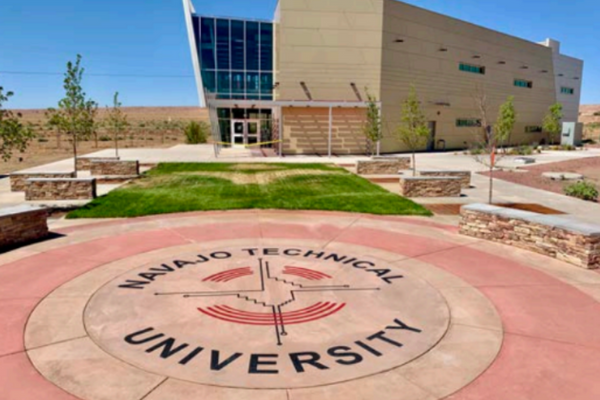
Navajo Technical University—a public university on the Navajo Nation in Crownpoint, N.M.— has launched an accredited doctoral program in Diné culture and language sustainability, making it the first of 36 tribal colleges and universities nationwide to offer a Ph.D.
The program opens to students in Fall 2023 and will integrate traditional Diné knowledge and western research methodologies to develop culturally-responsive practices to community-specific problems, according to the school’s press release.
According to University president Elmer Guy, the hope is to promote self-determination and empower students to become leaders across sectors, including education, health, local government, criminal justice, and elections.
The Navajo language is just one of the hundreds of Indigenous languages tribal nations have been working to build back from the brink of extinction. Although the Navajo language had more than 170,000 speakers as of 2019—more than any other tribal nation— it is still considered an “endangered language” by UNESCO “since each year fewer Navajo children speak the language fluently.”
Tell Us What You Think
According to a report by the Navajo Nation’s Department of Diné Education, only 30% of Navajo children are fluent in the language, compared to around 90% in the early 20th century.
Losing speakers of a language has far-reaching consequences for a nation’s overall health. Guy said many of the nation’s citizens only speak Navajo, which presents a threat at the courthouse, the ballots, the clinic, and beyond.
“If we are going to be sovereign, we’ve got to practice that throughout,” Guy said. “For a long time, the court transcribed didn’t Navajo, so when someone spoke Navajo, they would just put ‘inaudible.’ So we have trained court transcribers who will transcribe the Navajo language. We are [also] training people on how to interpret the election ballots [in Navajo]. The more that we put out with these skills with these tools, it will just add to the collection [of] knowledge and they’ll contribute to our nation in a good way.”
Navajo Technical University’s Ph.D. program prioritizes community-based research, Wafa Hozien, an administrator who helped with the program’s creation, told Native News Online.
In each course, students will look at real-life problems on the Navajo Nation and work toward developing solutions.
“The launch of our accredited Ph.D. program represents a paradigm shift in how we approach Indigenous language education and research,” Hozien said. “Our program offers a unique opportunity for community members to gain a deep understanding of the Diné language and culture and to empower themselves as advocates for language sustainability.”
While students may not have all the answers, the idea is to put them on the pathway to collaborative solutions “to create meaningful change,” Hozien said.
More than 20 students have already inquired about the Ph.D. application, Hozien said, though the program is only enrolling five students in its first cohort.
Faculty will include Dr. Siri Tuttle, an expert in Athabaskan linguistics and community-based research, and Dr. Franklin Sage (Diné), a scholar in Diné research in culture and history.
“Getting a Ph.D. means that a graduate can lead, conduct and publish research,” Tuttle said in a statement provided to Native News Online. “With the Navajo Technical University degree, it is intended to go further: to indicate that the graduate can do all these things in an ethical way that also makes sense in the Diné world.”
More Stories Like This
New UNLV Executive Certificate Focuses on Tribal Governance, Economic LeadershipBureau of Indian Education Graduation Rates Increase as Agency Reforms Fold into Interior and Labor Departments
Deb Haaland Announces Education Platform, Secures Teachers Union Backing
Native Americans Could Be Hit Hard as Education Department Resumes Student Loan Wage Garnishment
Hanging a Red Dress for Christmas: MMIP, Native Higher Education, and Hope for a Better New Year
Help us defend tribal sovereignty.
At Native News Online, our mission is rooted in telling the stories that strengthen sovereignty and uplift Indigenous voices — not just at year’s end, but every single day.
Because of your generosity last year, we were able to keep our reporters on the ground in tribal communities, at national gatherings and in the halls of Congress — covering the issues that matter most to Indian Country: sovereignty, culture, education, health and economic opportunity.
That support sustained us through a tough year in 2025. Now, as we look to the year ahead, we need your help right now to ensure warrior journalism remains strong — reporting that defends tribal sovereignty, amplifies Native truth, and holds power accountable.
 The stakes couldn't be higher. Your support keeps Native voices heard, Native stories told and Native sovereignty defended.
Stand with Warrior Journalism today.
Levi Rickert (Potawatomi), Editor & Publisher