- Details
- By Kaili Berg
A National Memorial in Northern Michigan is getting a $3.6 million makeover to more accurately portray the area’s Native American history.
The grant, received by The Michigan Department of Natural Resources (DNR), comes from the Mellon Foundation’s Monuments Projects, a $500 million commitment to transforming the nation’s commemorative landscape to ensure collective histories are more completely and accurately represented.

The Father Marquette National Memorial sits in the Straits State Park, St. Ignace. It was established in 1976 and told the story of Father Jacques Marquette, a French Jesuit who lived among the Great Lakes Indians from 1666 to his death in 1675.
During the nine years he was in the area, he learned several Native languages and dedicated his time to converting Native Americans to Catholicism. He joined Louis Jolliet in his expedition, which resulted in the French colonization of the Mississippi Valley.
The DNR said that Marquette’s and other Jesuit accounts from the period have long informed both historical accounts and attitudes toward the Native people of the Great Lakes.
The DNR’s Michigan History Center is developing the project with local, state, and Tribal partners. The project will recenter the narrative around the Anishinaabe (Odawa, Ojibwe, and Potawatomi) people and culture, according to the DNR in a press release.
The remodeled memorial will be called Gchi Mshiikenh Deh Minsing (Heart of the Great Turtle Island), named by the Sault Tribe. It will reflect the Anishinaabe view of the Great Lakes as the heart of North America and a creation story that begins at the Straits of Mackinac. Construction of the project will include new educational structures, exhibits, and art that include Native American context and perspective of the site, said the DNR.
“The project has an amazing potential to tell a story of the region that has been missing, a perspective led from Native Americans with ancestral ties to the area,” said Austin Lowes, chair of the Sault Ste. Marie Tribe of Chippewa Indians in a press release.
The Bay Mills Indian Community, Little Traverse Bay Band of Odawa Indians, and Match-E-Nash-She-Wish Band of Potawatomi Indians have joined the Sault Tribe in creating the site's historical content plan.
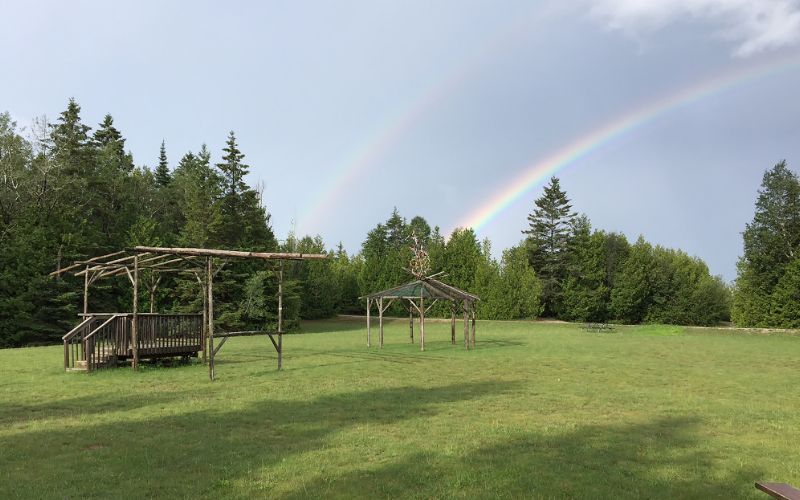
The associated Father Marquette Museum building was destroyed by a fire in 2000. The site where the building once stood is now used for annual powwows, for which the grant will cover new improvements.
The funding will support updates of information of the memorial, new structures at the site used for powwow grounds, a community kitchen pavilion for powwows and educational programs, new educational signage on trails, public art installations, program developments, and learning commons with classrooms and meeting spaces.
Construction on the learning commons, powwow ground structures and community pavilion is expected to begin this summer and is projected to be completed by 2025. The Anishinaabe-led committee will work on commissioning art for the site and partners will develop plans for programming for educators, students, residents, and visitors of the region.
“Many Anishinaabe descendants of those who knew Marquette are Catholic and honor his facility with their languages, his faith and his courage,” said Michigan History Center Director Sandra Clark in a press release. “It is a privilege that we can now also honor the culture that thrived before he arrived and remains an important part of Michigan.”
More Stories Like This
Native News Weekly (August 25, 2024): D.C. BriefsUS Presidents in Their Own Words Concerning American Indians
Two Murdered on Colville Indian Reservation
NDAA passes House; Lumbee Fairness Act Advances
NFL, Vikings to Host Native All-American Game, Youth Flag Clinic
Help us defend tribal sovereignty.
At Native News Online, our mission is rooted in telling the stories that strengthen sovereignty and uplift Indigenous voices — not just at year’s end, but every single day.
Because of your generosity last year, we were able to keep our reporters on the ground in tribal communities, at national gatherings and in the halls of Congress — covering the issues that matter most to Indian Country: sovereignty, culture, education, health and economic opportunity.
That support sustained us through a tough year in 2025. Now, as we look to the year ahead, we need your help right now to ensure warrior journalism remains strong — reporting that defends tribal sovereignty, amplifies Native truth, and holds power accountable.
 The stakes couldn't be higher. Your support keeps Native voices heard, Native stories told and Native sovereignty defended.
Stand with Warrior Journalism today.
Levi Rickert (Potawatomi), Editor & Publisher