- Details
- By Levi Rickert
In a historic ruling, the U.S. Supreme Court on Thursday decided colleges and universities cannot use race for consideration for admissions.
The ruling struck down affirmative action in public higher education institutions. In Thursday’s decision, the court ruled on admission practices at Harvard University and the University of North Carolina.
Using the 14th Amendment as the basis of his argument, Chief Justice John Roberts wrote the two universities' programs “violate the Equal Protection Clause of the Fourteenth Amendment," in his 6-3 majority opinion on both cases: Students for Fair Admissions v. President and Fellows of Harvard, and Students for Fair Admissions v. University of North Carolina.

President Joe Biden, a long-term supporter of affirmative action, pushed back on the Supreme Court’s decision.
“We cannot let the decision be a permanent setback for the country,” the president said during remarks at the White House after the decision was announced.
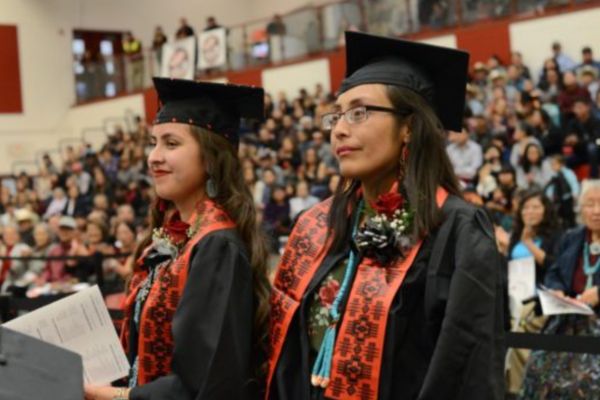
American Indians and Alaska Natives technically are not considered as being part of a race, but rather part of a political entity. However, university and college admission officials often do not know this. As a result, Thursday’s decision will impact American Indians and Alaska Natives in the future.
The American Indian College Fund wrote in a statement that affirmative action has provided worthy American Indian and Alaska Natives and other diverse students with the opportunity for an affordable higher education.
The four organizations that comprise the National Native Scholarships Providers (NNSP) — American Indian College Fund, American Indian Science and Engineering Society, Cobell Scholarship Program administered by Indigenous Education, Inc., and Native Forward Scholars Fund — issued the following statement on Thursday evening:
“We affirm that our students are citizens of Tribal Nations, thus possessing political status and citizenship rooted in the government-to-government relations of Tribes to the federal government. Their citizenship is separate from and woven with their Indigenous identities. Indigenous identity (American Indian and Alaska Native) is an identity that often provides pathways and supports for higher education access and success and can, therefore, be impacted by this ruling.”
The education advocates also included a message for Native youths in the statement.
“We also want to share a message with the youth in our many Indigenous nations across the country: Do not be discouraged. You belong where you dream to be. Your dreams are the fuel that will lead you to accomplishing your potential. You are worthy, you are more than deserving, and we are here for you, because we are depending upon your brilliance to lead and innovate in the future.”
The group called for better access and more acceptance of Native culture, writing: “The NNSP calls upon higher education institutions, policymakers, supporters of Indigenous education, and students to ensure our nation’s campuses are accessible to all, our students are welcome, and Native cultures and contributions are embraced. The United States is a better country when all voices are represented and included throughout all of society—including education.”
The National Congress of American Indians called the ruling "exceptionally disappointing" because, in part, it encourages "Native students to repress their culture and assimilate to Western ways of knowing."
In a statement, the NCAI wrote: "Today's Supreme Court decision on affirmative action is exceptionally disappointing and fails to take into account the realities centuries of destructive policies can have on a population. By encouraging Native students to repress their culture and assimilate to Western ways of knowing, the Federal government’s educational policy fostered a spirit of alienation amongst Native youth that has carried across generations and stifled academic achievement--particularly with respect to postsecondary institutions. While everyone deserves to be considered on their merits, it does more harm than good to ignore the fact that Native people were subject to genocide, colonization, and assimilation. Only when these realities are confronted head-on will meaningful progress be made, which is why the National Congress of American Indians will continue to fight to bring visibility to these issues and look for solutions to ensure future generations have access to the education so many of our past generations did not."
More Stories Like This
Hanging a Red Dress for Christmas: MMIP, Native Higher Education, and Hope for a Better New YearNative Students Can Win $5,000 Scholarship, International Distribution in Pendleton Design Contest
American Indian College Fund Raises Alarm Over Plan to Shift Native Programs Away From the Dept. of Education
MacKenzie Scott Foundation Gives $5 Million Contribution to Little Priest Tribal College
Tribal Leaders Push Back on Dismantling of U.S. Department of Education
Help us defend tribal sovereignty.
At Native News Online, our mission is rooted in telling the stories that strengthen sovereignty and uplift Indigenous voices — not just at year’s end, but every single day.
Because of your generosity last year, we were able to keep our reporters on the ground in tribal communities, at national gatherings and in the halls of Congress — covering the issues that matter most to Indian Country: sovereignty, culture, education, health and economic opportunity.
That support sustained us through a tough year in 2025. Now, as we look to the year ahead, we need your help right now to ensure warrior journalism remains strong — reporting that defends tribal sovereignty, amplifies Native truth, and holds power accountable.
 The stakes couldn't be higher. Your support keeps Native voices heard, Native stories told and Native sovereignty defended.
Stand with Warrior Journalism today.
Levi Rickert (Potawatomi), Editor & Publisher