- Details
- By Neely Bardwell
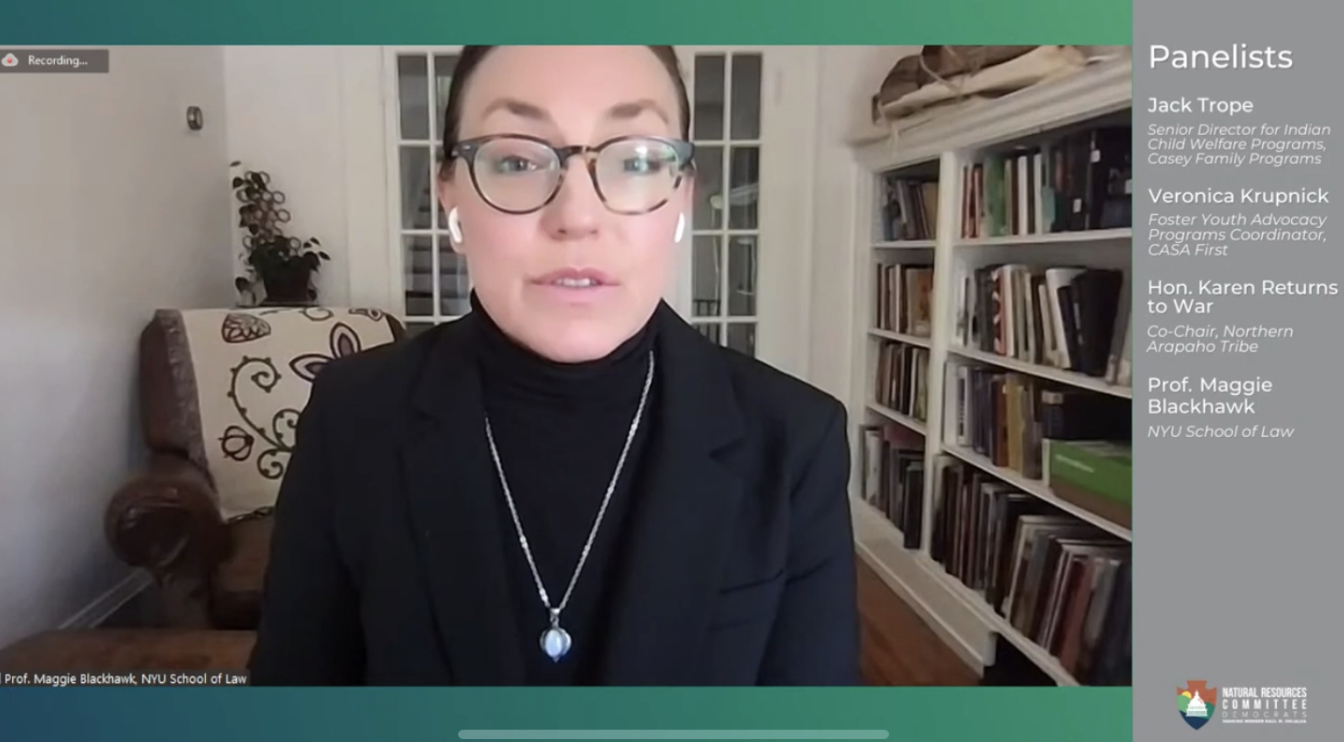
The roundtable, which examined the threat to the constitutionality of ICWA, featured four panelists who provided expert testimony. Panelists included: Maggie Blackhawk (Fond du Lac Band of Lake Superior Ojibwe), professor of law at New York University School; Jack Trope, Senior Director for Indian Child Welfare Programs at Casey Family Programs; Veronica Krupnick, Foster Youth Advocacy Programs Coordinator of CASA First; and Karen Returns to War, Co-Chair of the Northern Arapaho Tribe.
In her testimony, Maggie Blackhawk,connected the dots between Native children being taken from their homes and placed in Indian boarding schools to Native children being placed in foster care and being placed for adoption during testimony.
“Over time, as states assumed more responsibility for the welfare of Native children, they began removing those children from their homes at unprecedented levels,” Blackhawk said. “Eighteen states were explicit that privatizing support for Native children would further reduce welfare costs and fill remaining federal funding gaps because Native children required far fewer welfare dollars when placed in the home of a middle class or wealthy foster or adoptive family than in the home of a Native family living in poverty.”
ICWA was passed in 1978 and provided guidance to state governments in handling child abuse and neglect, and adoption cases involving children with tribal citizenship. The law set minimum standards of accountability and consideration in the event a Native child ends up in the system.
Before ICWA, Native children were systematically separated from their families and communities by state and private adoption agencies without evidence of harm or neglect. Eighty-five percent of these children were placed in non-Native homes. Now, ICWA requires caseworkers in each state to make “active efforts” to keep Native children within their communities.
Public interest in ICWA is at an all-time high due to the impending Supreme Court decision of Brackeen v. Haaland, a case that challenges the act's constitutionality. Arguments took place last November, and a decision is expected in late June.
The primary argument against ICWA is that it discriminates on the basis of race and prioritizes the interest of tribes over the needs of Native children.
Tribal nations and the U.S. Department of Interior responded to the argument of race discrimination by arguing that ICWA is not race-based but instead based on the fact that American Indian tribes and their citizens are a political class, and to challenge ICWA is to challenge Tribal sovereignty.
“Like many other child welfare and adoption organizations, Casey Family Programs considers ICWA to be the Gold Standard for child welfare,” Thorpe testified at Tuesday's roundtable. “ICWA emphasizes keeping children safely with their parents/guardians whenever possible (active efforts requirement) or, if they cannot be kept with their parents/guardians, keeping them connected with their relatives, communities, and cultures (placement preferences, community standards, transfer to tribal court). We know children thrive with their families and in their communities.”
Krupnick shared her personal experience with the child welfare system —she herself was an Indigenous child taken from her community.
“My value, my self-worth became directly tied to how much I believed my now-adopted parents and family wanted to keep me,” Krupnick said. “And with this driving belief—as a child, as a teen, as a young adult—I didn’t even realize I was hurting myself trying to mold into a person that I would never be and abandoning pieces of myself that were incredibly essential to my well-being and my healing. So instead of finding joy and connection and healing in my identity as an Indigenous person, these were replaced with feelings of guilt, anger, shame, and even embarrassment.”
In answer to the question if Congress had the constitutional right to pass the ICWA as posed by the Brackeen v. Haaland case, Blackhawk responded:
“The historical record confirms that the care and education of Native children fall squarely into the constitutional powers of Congress. The constitutional challenges to Brackeen are unfounded and could result in the deeply ironic situation where the constitutional values that we have elevated to reckon with other constitutional failures—specifically, the institution of human enslavement and Jim Crow segregation—might be used to further the American colonial project today.”
More Stories Like This
50 Years of Self-Determination: How a Landmark Act Empowered Tribal Sovereignty and Transformed Federal-Tribal RelationsGreen Corn Celebration Reconnects Ho-Chunk Nation to Ancestral Foods and Lands
Oceti Sakowin Treaty Councils Call for Emergency Action to Rescue the Lakota Language
Tipiziwin Tolman (Lakota) Appointed to UNESCO Global Task Force for Indigenous Language Revitalization
Five Tribes Announce the Formation of a New Chuckwalla National Monument Intertribal Commission
Help us tell the stories that could save Native languages and food traditions
At a critical moment for Indian Country, Native News Online is embarking on our most ambitious reporting project yet: "Cultivating Culture," a three-year investigation into two forces shaping Native community survival—food sovereignty and language revitalization.
The devastating impact of COVID-19 accelerated the loss of Native elders and with them, irreplaceable cultural knowledge. Yet across tribal communities, innovative leaders are fighting back, reclaiming traditional food systems and breathing new life into Native languages. These aren't just cultural preservation efforts—they're powerful pathways to community health, healing, and resilience.
Our dedicated reporting team will spend three years documenting these stories through on-the-ground reporting in 18 tribal communities, producing over 200 in-depth stories, 18 podcast episodes, and multimedia content that amplifies Indigenous voices. We'll show policymakers, funders, and allies how cultural restoration directly impacts physical and mental wellness while celebrating successful models of sovereignty and self-determination.
This isn't corporate media parachuting into Indian Country for a quick story. This is sustained, relationship-based journalism by Native reporters who understand these communities. It's "Warrior Journalism"—fearless reporting that serves the 5.5 million readers who depend on us for news that mainstream media often ignores.
We need your help right now. While we've secured partial funding, we're still $450,000 short of our three-year budget. Our immediate goal is $25,000 this month to keep this critical work moving forward—funding reporter salaries, travel to remote communities, photography, and the deep reporting these stories deserve.
Every dollar directly supports Indigenous journalists telling Indigenous stories. Whether it's $5 or $50, your contribution ensures these vital narratives of resilience, innovation, and hope don't disappear into silence.
 The stakes couldn't be higher. Native languages are being lost at an alarming rate. Food insecurity plagues many tribal communities. But solutions are emerging, and these stories need to be told.
Support independent Native journalism. Fund the stories that matter.
Levi Rickert (Potawatomi), Editor & Publisher