- Details
- By Levi Rickert
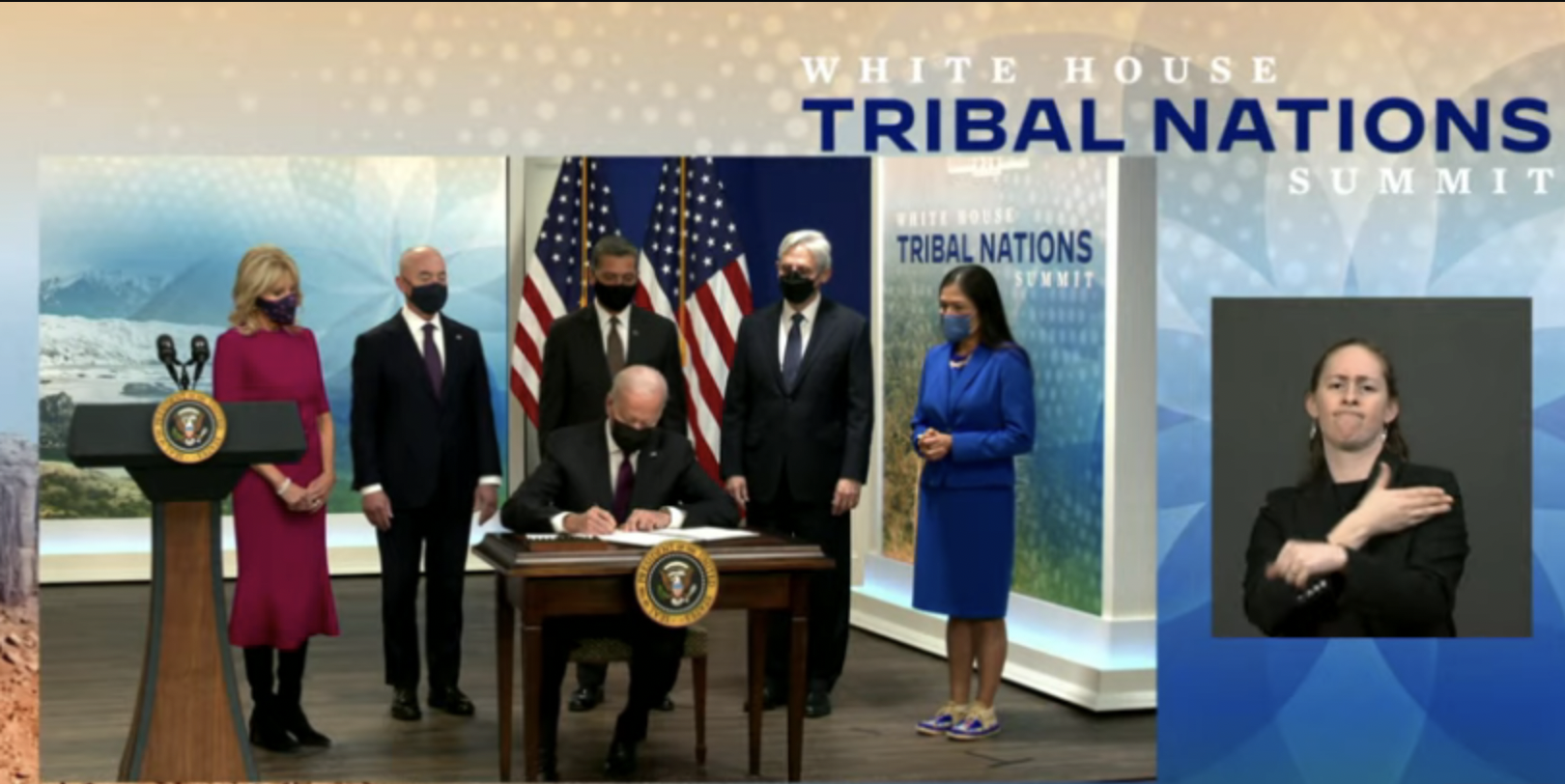
The Biden administration kicked off the first White House Tribal Nations Summit on Monday. It was the first such gathering since the Obama White House held its last Tribal Nation Conference in September 2016.
The summit began with a welcome form U.S. Secretary of the Interior Deb Haaland (Laguna Pueblo) followed by welcomes by President Joe Biden and first lady Jill Biden.
Want more Native News? Get the free daily newsletter today.
At the conclusion of his remarks, Biden signed a presidential executive order intended to strengthen public safety for tribal nations.
The White House Tribal Nations Summit is being held virtually due to the COVID-19 pandemic. Tribal leaders from around Indian Country appeared on a virtual screen as a backdrop to the program at the White House, where the summit is being broadcast.
“We understand we cannot address these challenges unless we partner with and honor our nation-to-nation relationship with tribes. You all are keepers of our traditions, the defenders of our resources and visionaries for our future. You and your communities harness Indigenous knowledge that we need to help guide our government – not just across budget years, but across generations,” Secretary Halaand said during her opening remarks.
Biden told tribal leaders “this is a big day” and reminded tribal leaders his American Rescue Plan included $31 billion for Tribal nations, the “most significant investment in the history of Indian country.” He also noted that the bipartisan infrastructure bill he will sign later today includes more than $13 billion in direct investments to Indian Country with intended benefits such as clean drinking water and high-speed Internet.
“We have to continue to stand up for the dignity and the sovereignty of tribal nations,” Biden said.
The president outlined five new initiatives from his administration: protecting tribal treaty rights, increasing tribal participation in management of federal lands, incorporating tribal ecological knowledge into the federal government’s scientific approach, taking action to protect the greater Chaco Canyon area in New Mexico from further oil and gas leasing, and signing a new executive order addressing violence against Native Americans.
Here is a breakdown of the five new Initiatives:
Tribal Treaty Rights Memorandum of Understanding. The Departments of Agriculture, Defense, Commerce, Education, Energy, Homeland Security, Housing and Urban Development, Interior, Justice, Labor, Transportation, Veterans Affairs, State, and the Environmental Protection Agency, Office of Personnel Management, the Advisory Council on Historic Preservation, and the Council Environmental Quality signed a Tribal Treaty Rights Memorandum of Understanding (MOU). The MOU provides that the agencies will determine how they can best protect Tribal treaty rights in their policymaking and regulatory processes. The MOU sets a timeline of 180 days for signatories to report back to the WHCNAA on their progress for strengthening the protection of Tribal treaty rights.
Tribal Homelands Joint Secretarial Order. In recognition of the importance of Tribal homelands under federal stewardship, the Departments of Agriculture and the Interior have launched the “Tribal Homelands Initiative” through a joint Secretarial Order. The Order commits the two Departments to increase opportunities for Tribal participation in federal lands management as well as co-stewardship agreements and other Tribal stewardship opportunities.
Greater Chaco Landscape Mineral Withdrawal. Located in Northwestern New Mexico, the Greater Chaco Landscape is a region of great cultural, spiritual, and historical significance to many Pueblos and Indian Tribes and containing thousands of artifacts that date back more than one thousand years. Chaco cultural sites were listed as a UNESCO World Heritage Site in 1987 and are one of only 24 such sites in the United States. For the past decade, Pueblos and Tribes in Arizona and New Mexico have raised concerns about encroaching oil and gas development threatening sacred and cultural sites, and Congress has passed a series of actions to temporarily defer new leasing. In the coming weeks, the Department of the Interior will initiate consideration of a 20-year withdrawal of federal lands within a 10-mile radius around Chaco Culture National Historical Park, protecting the area from new federal oil and gas leasing and development. The proposed withdrawal will not apply to Individual Indian Allotments or to minerals within the area owned by private, state, and Tribal entities. The action will also not impose restrictions on other developments, such as roads, water lines, transmission lines, or buildings. To support conservation of the area, the State of New Mexico Land Office has implemented a moratorium on new state mineral leases within a 10-mile radius of Chaco Culture National Historical Park.
Indigenous Knowledge Statement and Establishment of Interagency Working Group on Indigenous Traditional Ecological Knowledge. The Biden-Harris Administration issued a memorandum recognizing Indigenous Traditional Ecological Knowledge as one of the important bodies of knowledge that contributes to the scientific, technical, social, and economic advancements of our nation. With Tribal consultation and input from knowledge holders and practitioners, the Administration will develop a guidance document for federal agencies on how the collection and application of such knowledge can be mutually beneficial to Tribes, Native communities, and federal agencies and can strengthen evidence-based analysis and informed decision-making across the federal government. An Interagency Working Group on Indigenous Traditional Ecological Knowledge will gather input from Tribes and Native communities and prepare the guidance document for planned release in 2022.
Executive Order on Improving Public Safety and Criminal Justice for Native Americans and Addressing the Crisis of Missing or Murdered Indigenous People. On November 15, 2021, President Biden signed an executive order directing the Departments of Justice, Interior, Homeland Security, and Health and Human Services to create a strategy to improve public safety and justice for Native Americans and to address the epidemic of missing or murdered Indigenous peoples. President Biden tasked the DOJ, DOI, and DHS with addressing specific law enforcement issues, as well as providing support for Tribal Nations to implement Tribally centered responses. He also directed HHS to develop a plan for prevention and survivor support initiatives.
"This Summit demonstrates the Administration’s commitment to listening to Tribal priorities and being a good partner in supporting Tribal Nations and serves as an important opportunity to celebrate the progress we have made, and work together on a plan of action to move forward," the White House said in a fact sheet distributed to the media on Sunday evening.
More Stories Like This
Native News Weekly (August 25, 2024): D.C. BriefsUS Presidents in Their Own Words Concerning American Indians
NDAA passes House; Lumbee Fairness Act Advances
NFL, Vikings to Host Native All-American Game, Youth Flag Clinic
Senate Committee on Indian Affairs Passes 12 Bills to Strengthen Tribal Communities
Help us defend tribal sovereignty.
At Native News Online, our mission is rooted in telling the stories that strengthen sovereignty and uplift Indigenous voices — not just at year’s end, but every single day.
Because of your generosity last year, we were able to keep our reporters on the ground in tribal communities, at national gatherings and in the halls of Congress — covering the issues that matter most to Indian Country: sovereignty, culture, education, health and economic opportunity.
That support sustained us through a tough year in 2025. Now, as we look to the year ahead, we need your help right now to ensure warrior journalism remains strong — reporting that defends tribal sovereignty, amplifies Native truth, and holds power accountable.
 The stakes couldn't be higher. Your support keeps Native voices heard, Native stories told and Native sovereignty defended.
Stand with Warrior Journalism today.
Levi Rickert (Potawatomi), Editor & Publisher