- Details
- By Native News Online Staff
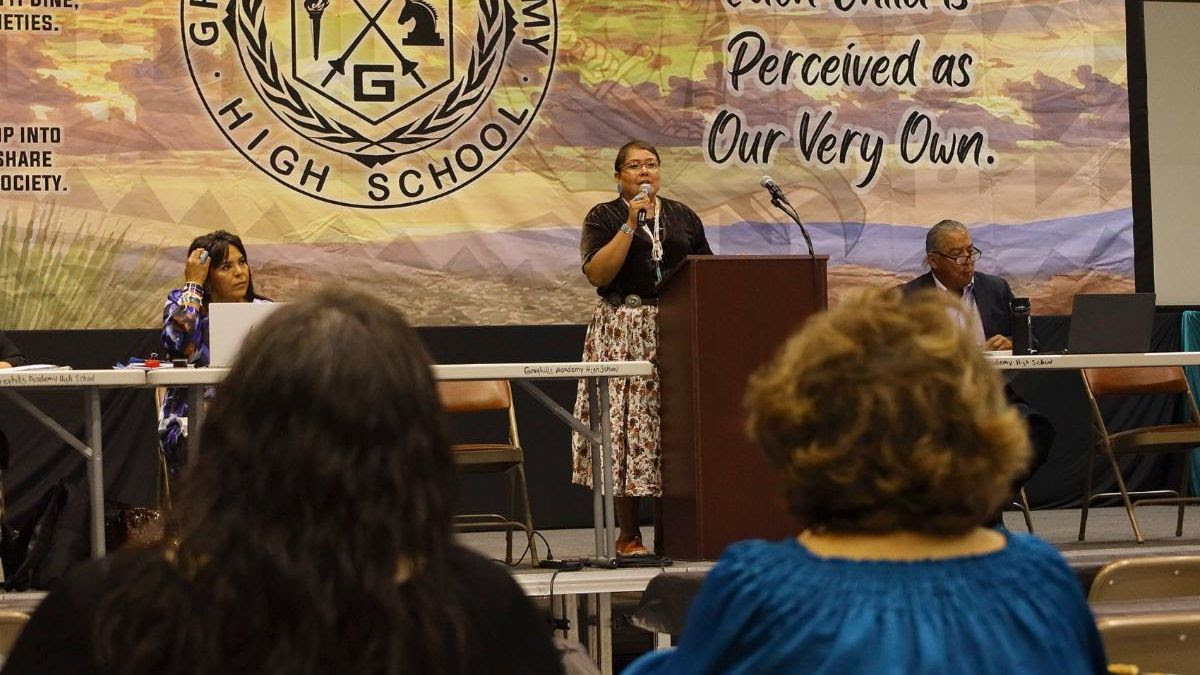
On Tuesday, June 17, Speaker Crystalyne Curley and Council Delegate Dr. Andy Nez met with representatives from the Department of Diné Education (DODE), Diné Bi Oltá School Board Association (DBOSBA), and the BIA Navajo Region to develop a unified response to the Bureau of Indian Education’s recent “Dear Tribal Leader” letter.
The meeting, held at Greyhills Academy High School, brought together key stakeholders from DODE, the BIA Navajo Region, the Bureau of Indian Education, and leaders of tribally controlled schools.
Speaker Curley emphasized the need for vigilance in opposing federal budget cuts and staffing reductions that threaten the education of Navajo students.
“These challenges aren’t new—we saw them coming,” Curley said. “We need collaboration. We must come together and advocate for our federal partners whose hands are tied and who can’t lobby for themselves.”
The Trump administration’s proposed FY 2026 budget includes a $187 million cut to BIE construction funding—part of a broader $617 million reduction across BIA programs.
Tribal leaders have voiced strong opposition to the proposed cuts, warning that they would disproportionately harm Native American students and communities, potentially leading to school closures, fewer educational offerings, and limited student services.
“Although these cuts aren’t final, we must continue to advocate with Congress,” Curley added. “These funds are critical for upgrading our school facilities, and we’re already operating under limited resources. Now, they’re proposing even less.”
She called for a unified approach to advocacy: “We need a united voice and shared priorities.”
Council Delegate Dr. Nez highlighted his ongoing collaboration with DODE, DBOSBA, and local school officials in response to the U.S. Department of the Interior’s April 14 letter, which announced a new round of Tribal Consultations.
These consultations are part of Executive Order 14210, titled “Implementing the President’s ‘Department of Government Efficiency’ Workforce Optimization Initiative,” which seeks to improve federal operations while honoring trust and treaty responsibilities.
Dr. Nez stressed the value of meeting with tribal nations directly in their communities to better understand local challenges.
“I enjoy visiting with my communities. When you sit at people’s tables and hear their stories, you gain real insight,” he said. “We’ve submitted a request to the U.S. Department of the Interior to hold a consultation here on the Navajo Nation. As the only tribal nation with its own area office, that should be achievable.”
He also underscored the importance of internal unity among Navajo education stakeholders when responding to federal actions.
“If we stay caught up in internal disagreements, we risk letting something harmful come from the federal government. We can’t miss any opportunity to respond,” he said.
Dr. Nez concluded by sharing that a resolution outlining the Navajo Nation’s formal position on the April 14 letter has been submitted to the Office of Legislative Counsel. The proposed legislation is scheduled for review at the upcoming Naabik’íyáti’ Committee meeting on June 26, 2025.
More Stories Like This
Native Students Can Win $5,000 Scholarship, International Distribution in Pendleton Design ContestAmerican Indian College Fund Raises Alarm Over Plan to Shift Native Programs Away From the Dept. of Education
MacKenzie Scott Foundation Gives $5 Million Contribution to Little Priest Tribal College
Tribal Leaders Push Back on Dismantling of U.S. Department of Education
American Indian College Fund Names 12 Student Ambassadors for 2025–26
Help us defend tribal sovereignty.
At Native News Online, our mission is rooted in telling the stories that strengthen sovereignty and uplift Indigenous voices — not just at year’s end, but every single day.
Because of your generosity last year, we were able to keep our reporters on the ground in tribal communities, at national gatherings and in the halls of Congress — covering the issues that matter most to Indian Country: sovereignty, culture, education, health and economic opportunity.
That support sustained us through a tough year in 2025. Now, as we look to the year ahead, we need your help right now to ensure warrior journalism remains strong — reporting that defends tribal sovereignty, amplifies Native truth, and holds power accountable.
 The stakes couldn't be higher. Your support keeps Native voices heard, Native stories told and Native sovereignty defended.
Stand with Warrior Journalism today.
Levi Rickert (Potawatomi), Editor & Publisher