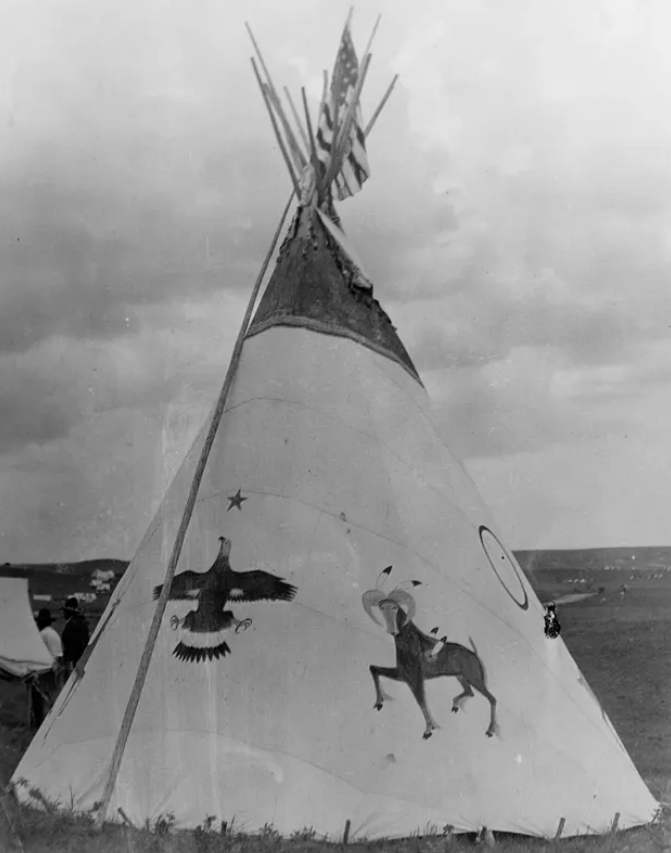
- Details
- By Neely Bardwell
On February 8, 1887, the Dawes Act, also known as the General Allotment Act, was passed by Congress. This Act ultimately allowed the Federal government to legally seize and break up tribal lands. This act was one of the pivotal pieces of the American Government’s attack on Native people and continuation of settler colonialism.
In part, this act aimed to assimilate Native Americans into the colonized society of individual farming and land plots. It also played a major role in removing Native peoples from their land, so the government could sell it off to the settlers.
Want more Native News? Get the free daily newsletter today.
The government gave Native Americans the option of accepting individual plots of up to 160 acres of farm land or 320 acres of grazing land that would be “given” to the head of each family. Only those who accepted this option would have the ability to be made U.S. citizens.
White Americans viewed this as “generous.” They viewed this as a “gift” to Native people.
Through the Dawes Act, over 90 million acres of land was taken from Native people. The land that they had lived on and taken care of for years—even generations—was stolen and then maybe returned at a fraction of what they lived on previously. This Act was not “gifting” this land back to them, but it was merely a tool of continued assimilation and displacement.
Even though many tribes were promised payment for the land that was taken from them, if they were paid, they were majorly short-changed.
This also separated communities and tribes by forcing them to live on separate plots of land. This was part of the government’s strategic plan to disassemble Native communities in order to make assimilating easier.
Forced into standardized ranching and farming, when some Native Americans were not accustomed to this way of life. On top of this, the land that they were forced to cultivate was often not suitable for farming.
More Stories Like This
Native News Weekly (August 25, 2024): D.C. BriefsUS Presidents in Their Own Words Concerning American Indians
NDAA passes House; Lumbee Fairness Act Advances
NFL, Vikings to Host Native All-American Game, Youth Flag Clinic
Senate Committee on Indian Affairs Passes 12 Bills to Strengthen Tribal Communities
Help us defend tribal sovereignty.
At Native News Online, our mission is rooted in telling the stories that strengthen sovereignty and uplift Indigenous voices — not just at year’s end, but every single day.
Because of your generosity last year, we were able to keep our reporters on the ground in tribal communities, at national gatherings and in the halls of Congress — covering the issues that matter most to Indian Country: sovereignty, culture, education, health and economic opportunity.
That support sustained us through a tough year in 2025. Now, as we look to the year ahead, we need your help right now to ensure warrior journalism remains strong — reporting that defends tribal sovereignty, amplifies Native truth, and holds power accountable.
 The stakes couldn't be higher. Your support keeps Native voices heard, Native stories told and Native sovereignty defended.
Stand with Warrior Journalism today.
Levi Rickert (Potawatomi), Editor & Publisher