- Details
- By Native News Online Staff
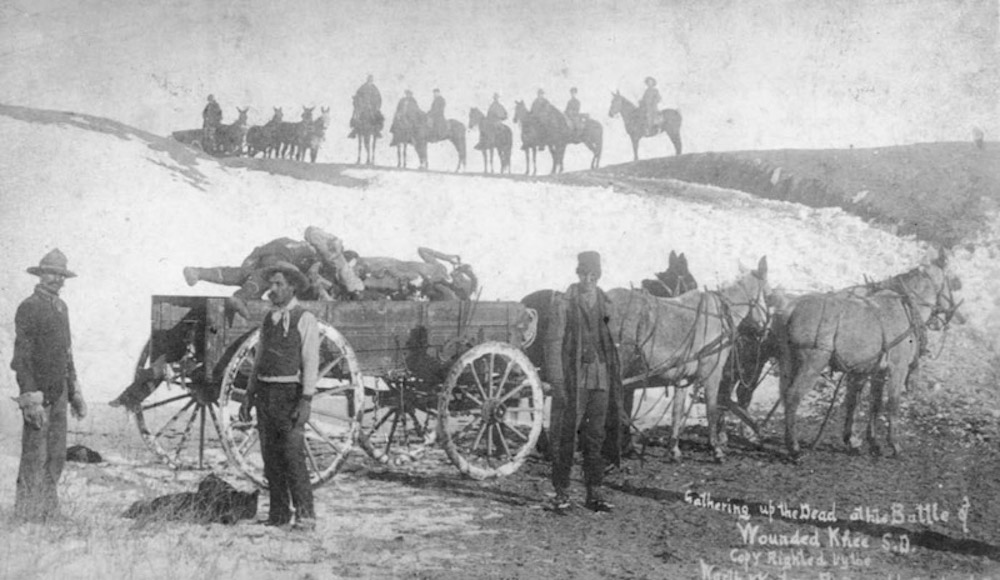
This Day in History. On Dec. 29, 1890, one of the darkest chapters in United States history unfolded on the frozen plains of South Dakota, when U.S. Army troops killed hundreds of Lakota men, women and children near Wounded Knee Creek. The massacre marked the violent end of the so-called Indian Wars and stands as a symbol of the federal government’s brutal campaign against Indigenous peoples.
In the days leading up to the massacre, tensions were high across the Great Plains. The Lakota people were suffering under U.S. policies that stripped them of their lands, confined them to reservations and cut already meager food rations. Amid widespread hunger and despair, many Lakota turned to the Ghost Dance, a spiritual movement promising the return of the buffalo and the restoration of Indigenous ways of life.
Please support our year-end campaign. CLICK HERE TO DONATE.

Federal officials, misunderstanding and fearing the movement, viewed the Ghost Dance as a threat. Orders were given to suppress it. On Dec. 15, 1890, Hunkpapa Lakota leader Sitting Bull was killed during an attempted arrest by Indian police, further inflaming tensions.
Several days later, Miniconjou Lakota leader Big Foot, also known as Spotted Elk, was leading his people toward Pine Ridge Reservation, seeking refuge. Suffering from pneumonia, Big Foot and his band were intercepted by the U.S. Army’s 7th Cavalry and escorted to Wounded Knee Creek.
On the morning of Dec. 29, soldiers attempted to disarm the Lakota. What happened next remains disputed, but a shot rang out. The troops opened fire with rifles and Hotchkiss cannons. Within minutes, the camp was engulfed in chaos.
When the gunfire stopped, as many as 300 Lakota were dead, most of them women and children. Many were shot while fleeing. Others froze to death in the snow after being wounded. Twenty-five soldiers were killed, some likely by friendly fire.
The massacre shocked even some contemporaries. Gen. Nelson A. Miles later called it “a horrible massacre of women and children.” Yet instead of accountability, the U.S. government awarded 20 Medals of Honor to soldiers who participated — a decision that remains deeply offensive to Native peoples and continues to be challenged by tribal leaders and members of Congress.
For the Lakota and Native nations across the country, Wounded Knee is not ancient history. It is living memory, carried through generations. Descendants of survivors continue to tell the stories, honor the dead and demand truth, justice and reconciliation.
In 1973, Wounded Knee again became a flashpoint when members of the American Indian Movement occupied the site for 71 days, drawing international attention to broken treaties, systemic injustice and the ongoing struggle for Native sovereignty.
Today, Wounded Knee stands as a solemn reminder of the human cost of colonization and U.S. expansion. Each year on Dec. 29, Native people and allies gather to remember those who were killed and to reaffirm resilience, survival and the enduring fight for Indigenous rights.
The Wounded Knee Massacre is not merely a tragic footnote in American history. It is a call to confront the truth, honor the victims and ensure such atrocities are never repeated.
More Stories Like This
Native News Weekly (August 25, 2024): D.C. BriefsUS Presidents in Their Own Words Concerning American Indians
Monday Morning (December 29, 2025): Articles You May Have Missed This Past Weekend
Native News Weekly (December 28, 2025): D.C. Briefs
Help us defend tribal sovereignty.
At Native News Online, our mission is rooted in telling the stories that strengthen sovereignty and uplift Indigenous voices — not just at year’s end, but every single day.
Because of your generosity last year, we were able to keep our reporters on the ground in tribal communities, at national gatherings and in the halls of Congress — covering the issues that matter most to Indian Country: sovereignty, culture, education, health and economic opportunity.
That support sustained us through a tough year in 2025. Now, as we look to the year ahead, we need your help right now to ensure warrior journalism remains strong — reporting that defends tribal sovereignty, amplifies Native truth, and holds power accountable.
 The stakes couldn't be higher. Your support keeps Native voices heard, Native stories told and Native sovereignty defended.
Stand with Warrior Journalism today.
Levi Rickert (Potawatomi), Editor & Publisher