- Details
- By Kaili Berg
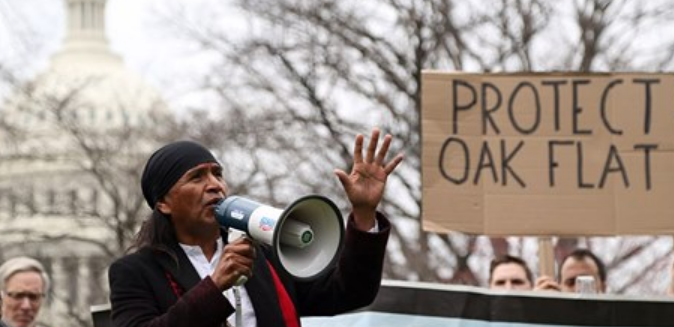
Apache Stronghold, a Native American advocacy group, has made a final legal plea to the U.S. Supreme Court to block the development of one of the world’s largest copper mines on sacred Arizona land.
The group, representing the San Carlos Apache tribe, has long opposed the efforts of mining giants Rio Tinto and BHP to gain access to Oak Flat, known to the Apache as Chi’chil Biłdagoteel, arguing that the project would destroy a key religious site.

Chi’chil Biłdagoteel, or Oak Flat, is a federally owned piece of land located in Arizona. It holds deep spiritual significance for the San Carlos Apache people and other tribes for time immemorial.
However, Oak Flat is also home to a vast copper reserve, estimated to contain over 40 billion pounds of the metal. Copper is a crucial material for the production of electric vehicles and electronics, making the land a prime target for resource extraction in the global shift toward renewable energy.
If a mine is built, the site would be transformed into a crater two miles wide and 1,100 feet deep, devastating the land’s sacred and ecological value.
The conflict over Oak Flat began in 2014 when Congress, under President Barack Obama, approved a land swap deal that would allow the federal government to transfer Oak Flat to Rio Tinto and BHP in exchange for other parcels of land.
This deal quickly sparked backlash from Apache Stronghold, which argued that the mining project would desecrate a sacred Apache worship site.
By 2015, the group had launched legal challenges and organized protests, raising awareness about the cultural and religious importance of Oak Flat. The case gained national attention as it became a flashpoint for the broader debate over Indigenous land rights and environmental justice.
In 2021, when President Joe Biden took office, he temporarily froze the land swap. However, the Biden Administration’s Department of Justice later argued in court that the federal government has the right to dispose of its land for national purposes, even if it interferes with religious practices.
The situation took a significant turn in March 2024 when the 9th U.S. Circuit Court of Appeals ruled in favor of the mining companies, allowing the land swap to proceed. Apache Stronghold vowed to continue their fights, taking the case to the U.S. Supreme Court.
In September 2024, Apache Stronghold delivered their appeal to the Supreme Court, following a months-long caravan from their Arizona reservation to Washington, D.C. The group then held a ceremony of prayer and dance on the steps of the Supreme Court.
For Apache Stronghold’s appeal to move forward, at least four Supreme Court justices must agree to hear the case. If the court accepts, oral arguments could begin as early as the next term, which starts in October 2024, with a decision potentially being issued by June 2025.
More Stories Like This
Trump signs law that revokes some limits on drilling in Alaska’s National Petroleum ReserveSouthern Sierra Miwuk Nation Gets 900-Acres ofLand Back
Chilkat Indian Village Tells New Palmer Mine Owners They Are “Not Welcome” in Chilkat Valley
Tribes, Coastal Group Ask Army Corps to Revoke Permit for Texas Export Terminal
Michigan Tribes Tell Supreme Court: Don’t Bail Out Enbridge
Help us defend tribal sovereignty.
At Native News Online, our mission is rooted in telling the stories that strengthen sovereignty and uplift Indigenous voices — not just at year’s end, but every single day.
Because of your generosity last year, we were able to keep our reporters on the ground in tribal communities, at national gatherings and in the halls of Congress — covering the issues that matter most to Indian Country: sovereignty, culture, education, health and economic opportunity.
That support sustained us through a tough year in 2025. Now, as we look to the year ahead, we need your help right now to ensure warrior journalism remains strong — reporting that defends tribal sovereignty, amplifies Native truth, and holds power accountable.
 The stakes couldn't be higher. Your support keeps Native voices heard, Native stories told and Native sovereignty defended.
Stand with Warrior Journalism today.
Levi Rickert (Potawatomi), Editor & Publisher