- Details
- By Jenna Kunze
NEW YORK—The Myth of Manhattan goes like this: Dutch settlers, arriving in 1626 on the island called Manahatta by its Lenape residents, believed they struck a deal with the Natives. For $24 worth of beads and trinkets, the Dutch believed they “purchased” the island, and soon built walls on the southern tip of the island—now Wall Street—to keep them out.
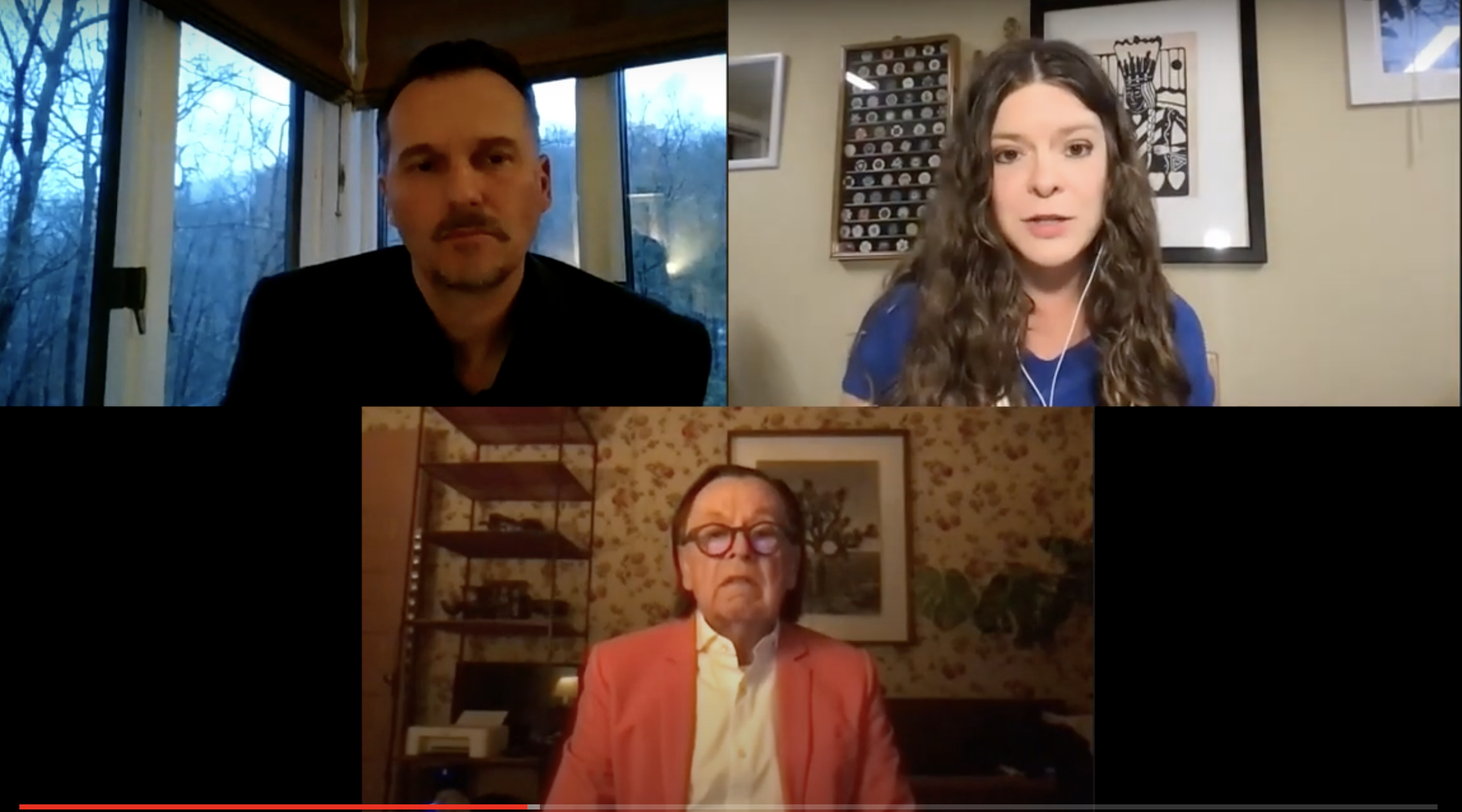
On Thursday, Brooklyn Public Library hosted a panel to dispel the myth of Manhattan with the co-founders of the nonprofit Lenape Center, Joe Baker (Lenape, Delaware Tribe of Indians of Oklahoma) and Hadrien Coumans (an adopted member of the Lenape WhiteTurkey-Fugate family). The panel was moderated by playwright and attorney Mary Kathryn Nagle (Cherokee Nation).
Want more Native News? Get the free daily newsletter today.
“It just plain couldn’t have happened for two reasons,” Nagle said in a video about the myth streamed during the remote event. “First, the Lenape had no concept of land ownership.” In other words, they did not believe that one could possess the earth to sell in the first place.
“And second,” Nagle continued, “the Dutch had struck the deal with Lenape men who didn't have the authority. In Lenapehoking (Lenape land), it was the women who made the big decisions.”
What Baker calls the “tenacious myth” circulating for the past 400 years covers the truth of his own origin story and how his family—who can trace their ancestral homelands directly to the center of what has become one of the most iconic cities in the world—ended up on a reservation in Oklahoma.
After the Dutch slowly pushed out the Lenape people, European settlers and eventually the U.S. government continued to push the Lenape people—who lived on homelands across the Northeast—onto five reservations in Oklahoma, Wisconsin, and Ontario.
“I think if we, as Americans, embrace … the American Dream, we have to rethink our beginnings,” Baker said.
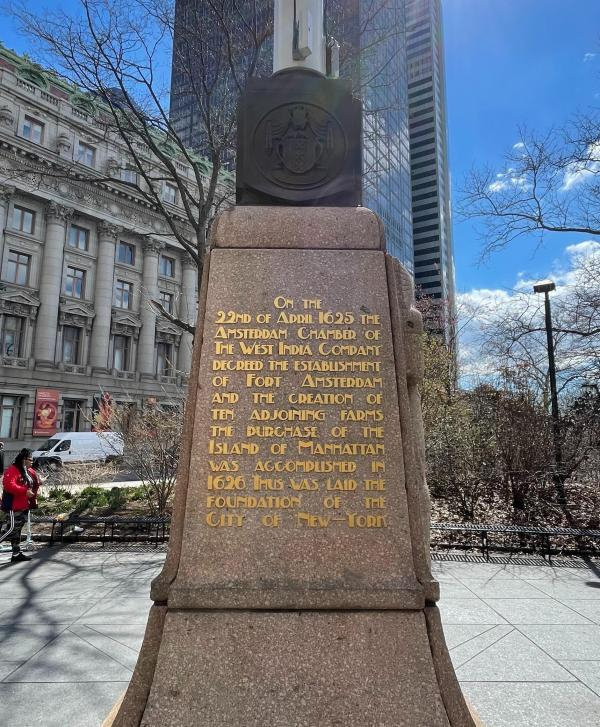 One of two plaques acknowledging the "sale" of Manhattan sits on the southern tip of the island in Battery Park. The monument, which was gifted by The Netherlands in 1926, makes no mention whatsoever of the Lenape People, or the mythic sale of their land. "Removing the plaque does not remove the history," Baker said. "I think a broader discussion around this plaque is the proper approach." (Photo/Jenna Kunze)By the 1630s, less than a decade after Manhattan was colonized, 90 percent of the Lenape population had died due to disease and massacres. “You have to also accept the truth of a genocide, and I think that's very difficult for people to embrace,” Baker said.
Baker and Coumans founded the Lenape Center in Manhattan in 2009 with a mission to continue Lenapehoking through community, culture, and the arts. Their long-term goal is to purchase their own physical space to enhance their platform, Coumans said.
Earlier this year, they opened the first ever Lenape-curated exhibit at the Brooklyn Public Library’s Greenpoint Branch. The exhibit includes Baker's own art: three handcrafted, beaded bags—called bandolier bags—that are worn by Lenape men on special occasions.
In order to move forward, Baker and Coumans agreed they’d first like to see New York City and its many powerful institutions recognize the truth, and then to work towards regenerating Lenape culture locally.
“The element of reconciliation begins with truth,” Coumans said. Baker proposed the city pass a resolution recognizing its original inhabitants.
“This is the cultural center of the world,” Baker said. “I mean, everything happens here in New York City. So if the institutions that have benefited and profited from being here, in Lenapehoking, on this soil, our ancestral land, could begin to open their doors .. to invite Lenape people home, that would be that would thrill me beyond all extremes. Bring them back to somehow express their creativity, their vision, their lifeways, in the homeland.”
In addition to his people, Baker also envisions bringing back the traditional ecology of Lenapehoking.
Since 2019, the Lenape Center has collaborated with a farm on Lenape land in the Hudson Valley in upstate New York to replant ancestral seeds in their native soil.
The seed rematriation project is the basis of an upcoming event in the Brooklyn Public Library Lenapehoking speaker series on April 14 at the Greenpoint Library in Brooklyn. To view and sign up for other events within the speaker series, including music by Brent Michael Davis (citizen of the Stockbridge-Munsee Band of the Mohican Nation) and poetry by Rebecca Haff Lowry ( Delaware Tribe of Indians), sign up here. Registration is free, and some events are available online.
More Stories Like This
Chickasaw Lighthorse Police Officer named Indian Country Law Enforcement Officer of the YearIndian Gaming Association Rallies Broad Coalition Against Sports Event Contracts It Calls Illegal Threat to Tribal Sovereignty
Navajo Resources and Development Committee Issues Notice on Livestock Inspection Requirements
American Prairie, Tribal Coalition Files Protest Over Rescinded Grazing Rights
Northern Cheyenne Push Back Against Trump Administration’s Effort to Alter Little Bighorn History
Help us defend tribal sovereignty.
At Native News Online, our mission is rooted in telling the stories that strengthen sovereignty and uplift Indigenous voices — not just at year’s end, but every single day.
Because of your generosity last year, we were able to keep our reporters on the ground in tribal communities, at national gatherings and in the halls of Congress — covering the issues that matter most to Indian Country: sovereignty, culture, education, health and economic opportunity.
That support sustained us through a tough year in 2025. Now, as we look to the year ahead, we need your help right now to ensure warrior journalism remains strong — reporting that defends tribal sovereignty, amplifies Native truth, and holds power accountable.
 The stakes couldn't be higher. Your support keeps Native voices heard, Native stories told and Native sovereignty defended.
Stand with Warrior Journalism today.
Levi Rickert (Potawatomi), Editor & Publisher