- Details
- By Native News Online Staff
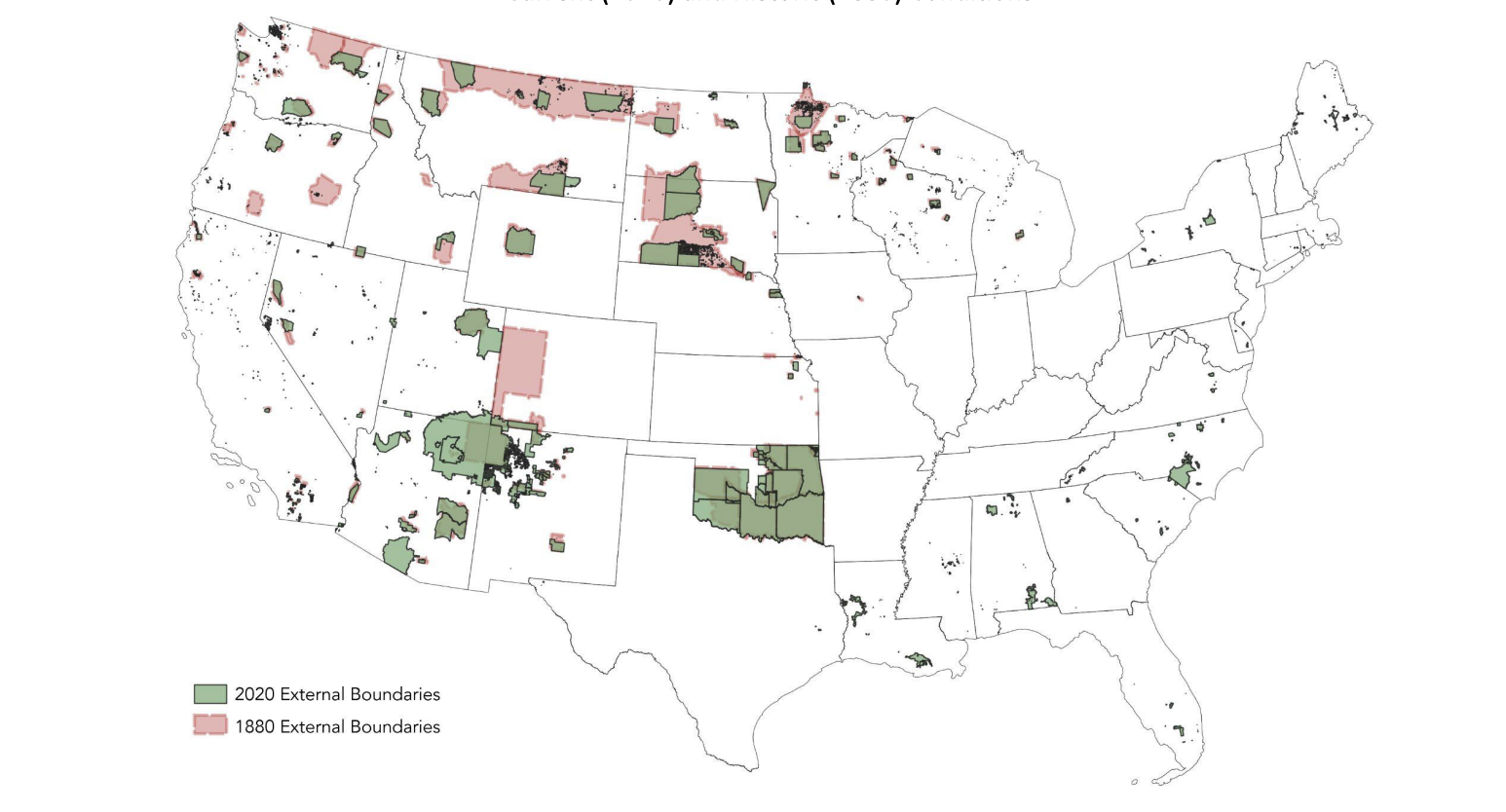
Researchers from the Harvard Project on American Indian Economic Development published a policy brief on Oct. 20 detailing how geographic information system (GIS) techniques can be used in landback efforts across Indian Country.
The report notes that six federal agencies currently manage approximately one-third of the land surrounding reservations that formerly belonged to Native nations.
Using geographic information systems helped the authors identify public and/or protected lands in relation to current and historic reservation boundaries. Between 1889 and 1890, Congress ceded about 13 million acres of reservation land to settlers through the General Allotment Act which authorized the president to break up reservation land.

GIS can show the scope of landback opportunities, including lands that are: owned by the federal or state governments; federal-or state-managed within current external reservation boundaries; existing within former reservation boundaries; near or bordering current reservation land; or protected areas designated for conservation management.
“Identifying where these parcels are is a powerful first step for tribes and government agencies to begin to develop strategies for landback,” wrote authors Miriam Jorgensen, Harvard Project on American Indian Economic Development (Harvard Project) research director, and Laura Taylor, Harvard Project research fellow.
More Stories Like This
50 Years of Self-Determination: How a Landmark Act Empowered Tribal Sovereignty and Transformed Federal-Tribal RelationsTlingit Haida Tribal Business Corporation Clarifies Federal Contracting Work
Homeland Tour Offers Deeper Understanding, Appreciation of Chickasaw Roots
Klamath Tribes Seek to Reverse Judge’s Removal in Water Rights Case
Tunica-Biloxi Chairman Pierite Elected President as Tribal Nations Unite Behind New Economic Alliance
Help us defend tribal sovereignty.
At Native News Online, our mission is rooted in telling the stories that strengthen sovereignty and uplift Indigenous voices — not just at year’s end, but every single day.
Because of your generosity last year, we were able to keep our reporters on the ground in tribal communities, at national gatherings and in the halls of Congress — covering the issues that matter most to Indian Country: sovereignty, culture, education, health and economic opportunity.
That support sustained us through a tough year in 2025. Now, as we look to the year ahead, we need your help right now to ensure warrior journalism remains strong — reporting that defends tribal sovereignty, amplifies Native truth, and holds power accountable.
 The stakes couldn't be higher. Your support keeps Native voices heard, Native stories told and Native sovereignty defended.
Stand with Warrior Journalism today.
Levi Rickert (Potawatomi), Editor & Publisher