- Details
- By Native News Online Staff
WINDOW ROCK, Ariz. — At the outset of the Covid-19 pandemic last year, some Indian Country leaders knew it would be difficult, perhaps even impossible, to comply with the CDC’s 20-second hand washing guidance.
Why? Because some reservation residents don’t have running water in their homes.
In the Feb. 3, 2021 edition of Bulletin of the Atomic Scientists, “Radiation illnesses and Covid-19 in the Navajo Nation,” Navajo Nation residents are 67 times more likely not to have running water or indoor plumbing connected to sewer lines than others in the United States.
This lack of water infrastructure has been disastrous for tribes as they've battled to slow the spread of the virus.
To help combat the problem, the Navajo & Hopi Families Covid-19 Relief Fund created the Clean Hands Project to distribute hand washing stations to families on the Navajo and Hopi Nations that don’t have access to indoor plumbing or running water.
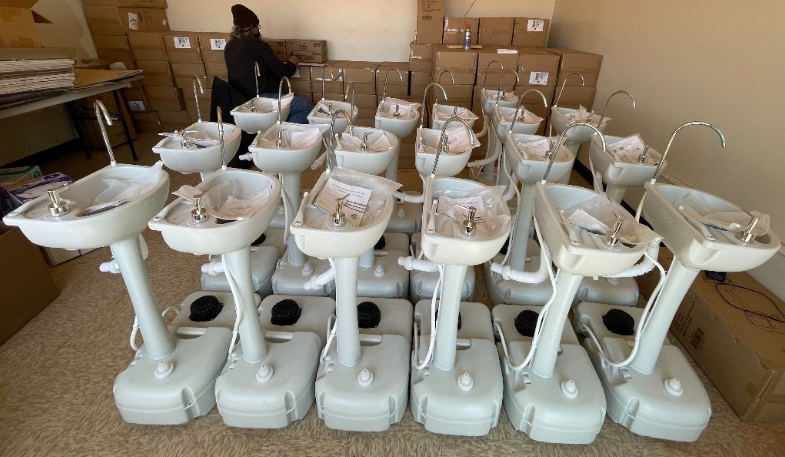
The hand washing stations consist of a stand that is approximately three-feet in height with a foot pump for hands-free water disbursement, a hand-washing basin, a container that holds fresh water and a liquid soap dispenser.
“In the Navajo Nation, 30 percent of homes lack indoor plumbing. Factors such as these contribute to disproportionate numbers of confirmed cases and deaths related to Covid-19 being reported among tribal communities in Arizona,” Relief Fund Interim Executive Director Ethel Branch said. “Although the Center of Disease Control and Prevention advocates for measures like hand washing to help decrease the spread of Covid-19, many of our tribal members cannot simply turn on a faucet to wash their hands.”
The idea to create the Clean Hands Project began in the fall of 2020 when Relief Fund Board Members identified that over a third of the families requesting Kinship Care Packages (which include food, water, and PPE) also lacked running water.
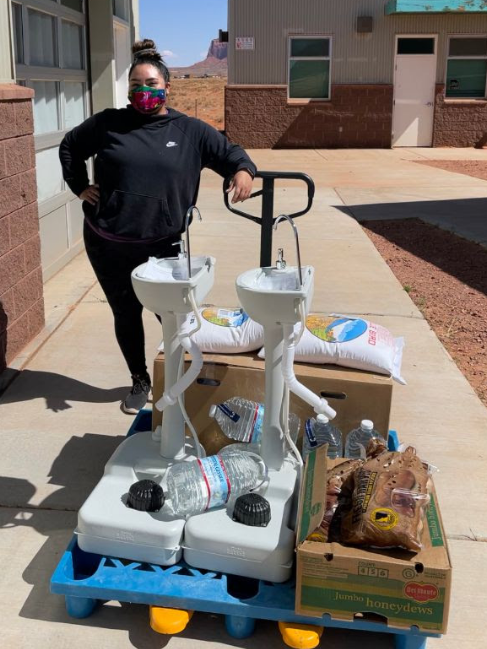 Board Secretary and Distribution Team Lead for Monument Valley, Utah, Shandiin Herrera stands next to a pallet jack loaded with food boxes and hand washing stations for distribution.
Board Secretary and Distribution Team Lead for Monument Valley, Utah, Shandiin Herrera began conducting outreach through local elder centers and community members within her region to further assess the need for hand washing stations. Many residents in her region live off the grid, which complicated the outreach effort.
“In many cases, it’s very difficult to contact those in need. Many residents of Douglas Mesa and other communities don’t have running water or electricity. On top of this, they don’t have internet or phone services to request our assistance,” Herrera said. “I had to be resourceful in communicating through our community members to assess the need that exists. In this, our teams have been very effective.”
Based on her outreach, Herrera assessed that out of 400 homes in her region, 175 households didn’t have running water. Since December 2020, the Relief Fund has been able to provide 60 hand washing stations to communities in Monument Valley, Utah. Herrera said she has 300 stations available and ready for distribution, which she conducts on a weekly basis.
Since the inception of the Clean Hands Project, the Relief Fund has been able to assess that 3,436 households that have requested their assistance on both the Navajo and Hopi Nations live without running water. These numbers are compiled in a database that guides the Project’s distribution of hand washing stations.
Relief Fund Program Manager Mary Francis said her objective with the Clean Hands Project is to distribute stations based on regional needs while prioritizing elders, confirmed Covid-19 cases and special needs individuals.
“We have a system in place where I delegate distribution to our regional team leads and they provide delivery and assembly of the hand washing stations,” Francis said. “Our strategy is to move from region to region and make sure that everyone who doesn’t have running water will at least have a hand washing station to help prevent the spread of Covid-19.”
The Clean Hands Project has distributed hand washing stations in the communities of Jeddito, LeChee, Coppermine, Kaibeto, Kayenta, Black Mesa, Kinlichee, Wide Ruins, Klagetoh and chapters surrounding Gallup, N.M. The Project continues to monitor and assess regional needs for distribution.
“The elders we’ve serviced have been so grateful for something as simple as a sink to wash their hands in as opposed to using buckets filled with water. They’re often amazed at the innovation of the hand washing stations we deliver,” Herrera said.
Please visit http://navajohopisolidarity.org to learn more about the Navajo & Hopi Families COVID-19 Relief Fund and to place a donation towards their coronavirus relief efforts.
More Stories Like This
Native News Weekly (August 25, 2024): D.C. BriefsUS Presidents in Their Own Words Concerning American Indians
Native News Weekly (December 14, 2025): D.C. Briefs
Wounded Knee Massacre Site Protection Bill Passes Congress
Two Murdered on Colville Indian Reservation
Help us defend tribal sovereignty.
At Native News Online, our mission is rooted in telling the stories that strengthen sovereignty and uplift Indigenous voices — not just at year’s end, but every single day.
Because of your generosity last year, we were able to keep our reporters on the ground in tribal communities, at national gatherings and in the halls of Congress — covering the issues that matter most to Indian Country: sovereignty, culture, education, health and economic opportunity.
That support sustained us through a tough year in 2025. Now, as we look to the year ahead, we need your help right now to ensure warrior journalism remains strong — reporting that defends tribal sovereignty, amplifies Native truth, and holds power accountable.
 The stakes couldn't be higher. Your support keeps Native voices heard, Native stories told and Native sovereignty defended.
Stand with Warrior Journalism today.
Levi Rickert (Potawatomi), Editor & Publisher