- Details
- By Levi Rickert
Ancestry research in the modern age is often reduced to DNA, three rather impersonal letters that clinically reveal our genetic instructions and hereditary traits. Thirty-two Chickasaw citizens’ desire to experience a deeper, more personal understanding of their origin than science could provide were amply fulfilled during the most recent Chickasaw Nation Elders Homeland Tour.
Before Removal to Indian Territory (present-day Oklahoma) in 1837, the historic Chickasaw Homeland consisted of approximately 37,000 square miles in present-day north Mississippi, northwest Alabama, southwestern Kentucky and western Tennessee.
Please support our year-end campaign. CLICK HERE TO DONATE.

Touring parts of the area made Don Yegge, a Chickasaw citizen from Loyalton, California, want to learn more about exactly where his First American ancestry originated.
“I don’t think the Homeland trip could have been any better,” Yegge said. “My grandfather was born in Willis, near Kingston (Oklahoma), but I’d never given any thought to where his father or his grandfather (were born and lived).
“My grandfather’s grandfather was Governor Benjamin Franklin Overton, and that’s all I really know about him,” Yegge said. “There is a picture of him in the Chickasaw Capitol, but now I’m curious to know a little more about what we saw yesterday and the day before. Were they in any of those places?”
Kim Babineaux from Luling, Louisiana, said the Sept. 15-19 Elders Homeland Tour gave her a deeper understanding of how Chickasaws prospered despite never enjoying the conveniences people take for granted today.
“It was very informative and has given me a different perspective on how the Chickasaws lived in their first Homeland,” Babineaux said.
Babineaux’s father recently passing away at age 91 added to the poignancy of her experiences visiting the Homeland.
“He was so interested in his Chickasaw heritage, which made me interested in mine,” she said. “It was something we shared.”
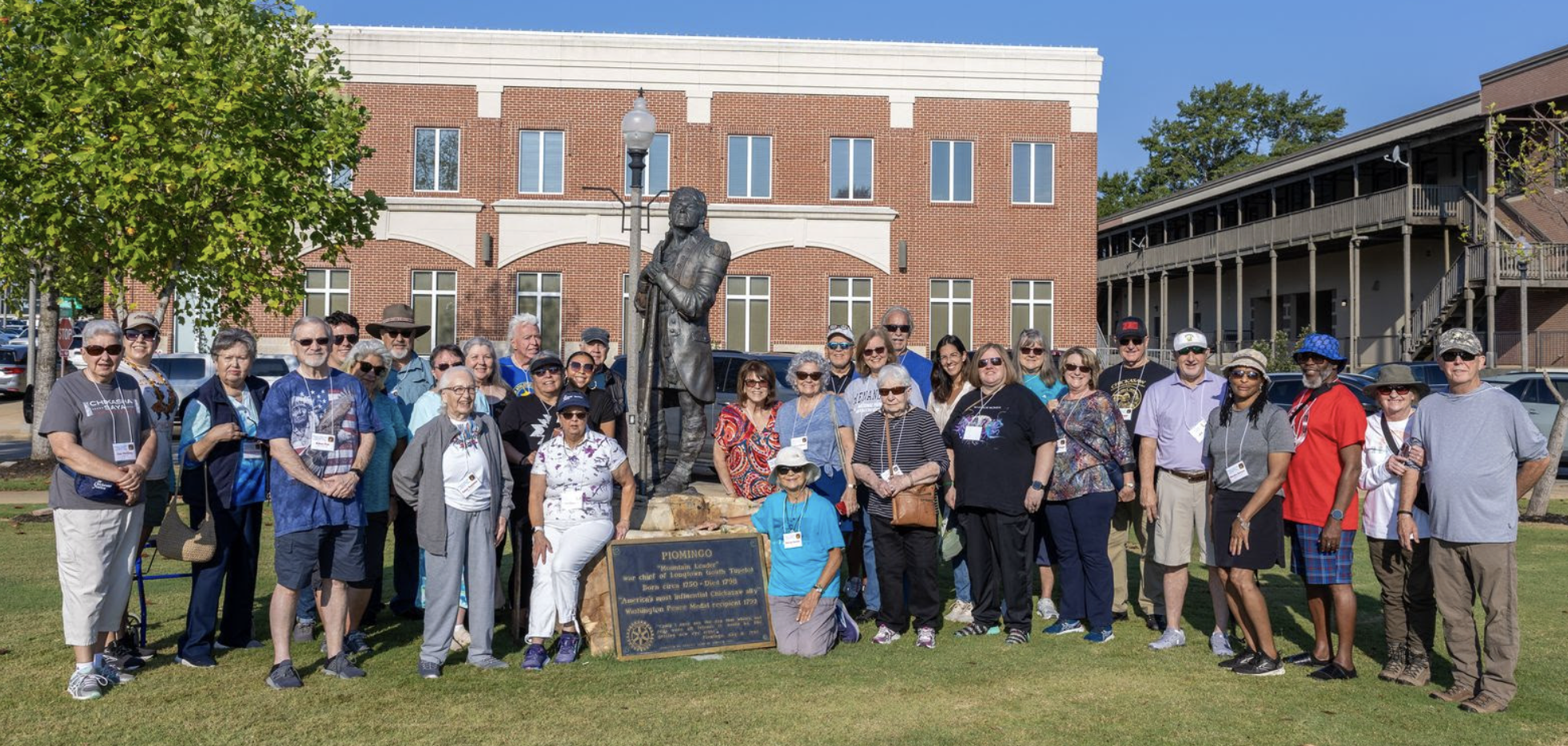
The tour’s first stop was at Tupelo, Mississippi’s Fairpark, which features a statue of Piominko, famous Chickasaw leader and friend of President George Washington. His stately and dignified presentation predates another statue on the other side of the park commemorating Elvis Presley.
Tour guide “Bill” Brekeen said Piominko’s statue depicts him gazing to the east in the direction of Tupelo’s city hall.
“Piominko was pro-American and instrumental in bridging a great relationship with the Americans,” Brekeen said.
“Piominko, one of our great leaders and diplomat in the 18th century, was known as a visionary,” Brekeen said. “He was born about 1750, approximately 8 miles to our north, where most Chickasaws were concentrated at this time.”
Babineaux said she saw parallels to Piominko’s leadership and that of today’s Chickasaw Nation.
"When we were at the Piominko statue, it occurred to me you can see the leadership at those critical junctures of time, the great insights, foresight, business savvy and statesmanship,” she said.
“The connection we had between the tribe and the American government lent itself for a different experience during the Removal because of that leadership,” Babineaux said. “When you look at present-day Chickasaws, it’s that same kind of statesmanship, leadership and business savvy, all those same qualities that set us apart.”
Brekeen, cultural interpreter for the Chickasaw Nation Heritage Preservation Division, said Piominko defined the historic Homeland boundaries that would be portrayed on a map.
“He was at the Treaty of Hopewell in 1786, and at that gathering and treaty site, he described the water courses, the rivers and other natural features of the historic Homeland,” Brekeen said.
“Any time there was a dispute about property and boundaries, he would pull the map out and say, ‘This was given to me by George Washington, and these are our boundaries.’”
Brekeen said upon Piominko’s death, the map passed to George Colbert, another great Chickasaw leader, to be used in treaty negotiations and to settle disputes.
Another site toured was Longtown Chickasaw Monument, illustrative of ancient Chickasaw families living above waterways on high ridgelines up to 10 to 12 miles long, in part to maintain a vantage point over attacking forces. Waterways below served as their primary modes of transportation, trade routes and water sources.
Clearing the area of oak trees, gum, hickory and other species provided firewood and wood for constructing dugout canoes, winter houses, summer houses and corn cribs, as well as brush arbors for shade and agriculture.
It was Longtown where construction at North Mississippi Medical Center was halted to allow for excavation of the remains of Chickasaw ancestors who were reinterred at an undisclosed location.
Chickasaw Nation Governor Bill Anoatubby and other dignitaries conducted a ceremony and a blessing on the site to honor the memory of those ancestors.
The Longtown site is considered a spiritual place, and to that end, Chickasaw citizen John Burkhart of Kemp, Texas, led in prayer, and Carolyn Cooper and granddaughter Cari Spain of Ardmore, Oklahoma, sang “Amazing Grace.”
Chisha' Tꞻlla'a' (Postoak Grove), also known as the Chickasaw Preserve, is a 38-acre tract of land in the Tupelo area, once the site of a Chickasaw village. It is owned by The Archaeological Conservancy, and leased to and managed by the Chickasaw Nation. It is designed as a place of reflection and is also a site to restore and cultivate native plants.
“It’s a place to reflect and pray, but it also establishes a spiritual connection for Chickasaws to this area,” Brekeen said.
A tour of the Pontotoc Post Office and Museum was followed by a visit to Owl Creek and Bynum Mounds. Owl Creek Mounds dates to the early Mississippian period around A.D. 1000 to 1200, and Bynum Mounds dates to the Middle Woodland period around 100 B.C. to A.D. 100. Mounds are thought to have been the focal points for social, ceremonial and religious purposes.
The Chickasaw Village Site is situated along the 444-plus-mile Natchez Trace Parkway, whose beautifully scenic two-lane route seems permanently lined with shadows created by trees hovering on either side.
The Natchez Trace Parkway begins in Natchez, Mississippi, and runs through much of the state into the northwest corner of Alabama before ending near Nashville, Tennessee.
It serves as the conduit for multiple touring opportunities, including the Natchez Trace Parkway Visitor Center and Headquarters, the Pharr Mounds, Cave Springs and Bear Creek Mound in northeast Mississippi.
Continuing into Alabama, one finds Buzzard Roost Spring, where Chickasaw leader Levi Colbert operated a business from 1801 to 1813 in which travelers could stop for overnight lodging, and have a meal and their horses cared for.
According to the Chickasaw Hall of Fame website, Levi Colbert and his brother George were prominent and shrewd Chickasaw negotiators. Before Removal, the brothers and other Chickasaw leaders bargained for as much compensation as possible for their Homeland.
Among other things, George Colbert is famous for having operated a ferry across the Tennessee River.
Not far off the Natchez Trace Parkway is Shiloh National Military Park in Shiloh, Tennessee, the site of a fierce Civil War battle and also the home of Shiloh Mounds.
The last stop was at Pinson Mounds State Archaeological Park, which features the 72-foot-tall Sauls’ Mound, one of the largest of the Middle Woodland period mounds in the United States.
Jimmie Nelson and sister Sharon Ratliff from Chigley, Oklahoma, said they were greatly impressed with every aspect of their five-day tour of the historic Chickasaw Homeland.
“The trip was fantastic,” Nelson said. “It was more than what I expected, a lot more. I did not realize there was so much history there. It has really impressed me. Bill (Brekeen), our tour guide, has been a walking encyclopedia. He does know his stuff.”
Ratliff said one of her big takeaways was the ingenuity of the First Americans who constructed mounds with no modern equipment.
“They were so smart to be able to engineer everything, to make do with what they had,” Ratliff said. “They didn’t waste anything. Their building ability just amazes me with only rocks and bones and sticks to build mounds and shelters. It has been interesting and amazing what we’ve learned.”
Chickasaw elders 60 years of age or older can participate in the all-expenses-paid trip to the historic Chickasaw Homeland. Multiple Homeland trips take place each calendar year, with elder applications being selected at random. An elder is required to submit only one application for consideration for future tours. Elders selected for the tour are permitted one travel companion who must be a spouse or blood relative above the age of 21.
More Stories Like This
50 Years of Self-Determination: How a Landmark Act Empowered Tribal Sovereignty and Transformed Federal-Tribal RelationsKlamath Tribes Seek to Reverse Judge’s Removal in Water Rights Case
Tunica-Biloxi Chairman Pierite Elected President as Tribal Nations Unite Behind New Economic Alliance
NCAI, NARF Host Session on Proposed Limits to Federal Water Protections
Help us defend tribal sovereignty.
At Native News Online, our mission is rooted in telling the stories that strengthen sovereignty and uplift Indigenous voices — not just at year’s end, but every single day.
Because of your generosity last year, we were able to keep our reporters on the ground in tribal communities, at national gatherings and in the halls of Congress — covering the issues that matter most to Indian Country: sovereignty, culture, education, health and economic opportunity.
That support sustained us through a tough year in 2025. Now, as we look to the year ahead, we need your help right now to ensure warrior journalism remains strong — reporting that defends tribal sovereignty, amplifies Native truth, and holds power accountable.
 The stakes couldn't be higher. Your support keeps Native voices heard, Native stories told and Native sovereignty defended.
Stand with Warrior Journalism today.
Levi Rickert (Potawatomi), Editor & Publisher