- Details
- By Kaili Berg
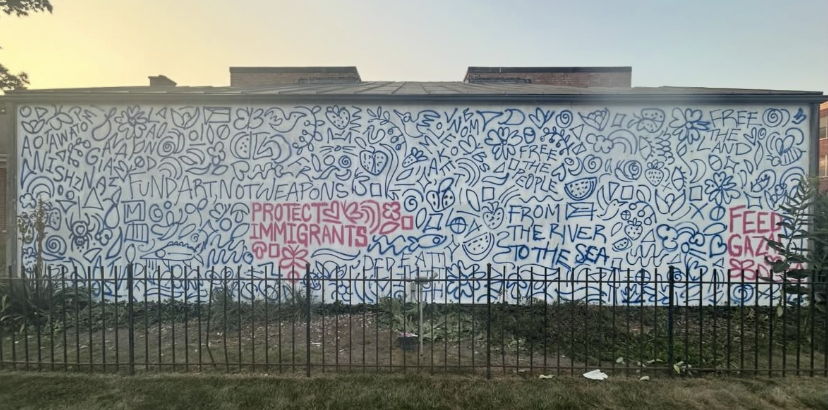
John was commissioned to create a mural based on Anishinaabe creation stories featuring Sky Woman, Thunderbird, and Nanaboozhoo. However, while laying down a preparatory "doodle grid," John embedded phrases such as "Feed Gaza," "Free the Land," and "From the River to the Sea," along with symbols like olive branches, watermelons, and doves.
Although John said the underpainting would have been covered by the final design, the museum viewed the additions as a violation of their contract. The board terminated John's agreement and had the mural whitewashed before completion.
In a statement to Native News Online, the museum's board said its decision was not driven by outside complaints or funding threats.
"The visuals on our building were not part of the approved design for the commissioned mural," the museum board said. "The artist was contracted to create a work reflecting the cultural elements of Indigenous communities of the Great Lakes region. The imagery that appeared on August 7th was neither submitted for review nor authorized by the museum and did not align with the agreed scope. We made the immediate decision to cover the imagery and end our agreement with the artist."
When asked whether safety concerns factored into the temporary closure, the board acknowledged they had seen "disturbing social media posts" and said staff well-being was a factor in shutting down temporarily. Still, they maintained that the choice to terminate John's contract was an internal decision made "as soon as we became aware of the discrepancy," not one influenced by complaints or external pressure.
John, who had been promised $24 an hour, said they were never paid and felt silenced and betrayed by the decision.
"I was betrayed and abandoned by an institution that censored, removed, and silenced the call for freedom to the Palestinian people," John told Native News Online, adding that many Native people in Chicago view Palestinians as fellow Indigenous peoples resisting colonial oppression.
The museum closed its doors from August 11–16, citing staff safety concerns.
This follows another incident of a Native artist expressing support for Palestine having a contract for mural work canceled.
Last year, Lakota artist Danielle SeeWalker had a residency in Vail, Colorado, canceled after the town deemed her recent painting, "G is for Genocide," "too political." Like John, SeeWalker was denied dialogue despite having already signed a contract and planned community programming. The ACLU sued the city of behalf of Seewalker, and the lawsuit was settled last month.
Both artists see the experience as part of a larger pattern of suppression.
"I can't help but take this personally as silencing not only an artist, but a person of color," SeeWalker said in a statement. "This piece of artwork has nothing to do with the Town of Vail. It had never been brought to the Town of Vail's attention."
More Stories Like This
Chickasaw Holiday Art Market Returns to Sulphur on Dec. 6Center for Native Futures Hosts Third Mound Summit on Contemporary Native Arts
Filmmakers Defend ‘You’re No Indian’ After Demand to Halt Screenings
A Native American Heritage Month Playlist You Can Listen to All Year Long
11 Native Actors You Should Know
Help us defend tribal sovereignty.
At Native News Online, our mission is rooted in telling the stories that strengthen sovereignty and uplift Indigenous voices — not just at year’s end, but every single day.
Because of your generosity last year, we were able to keep our reporters on the ground in tribal communities, at national gatherings and in the halls of Congress — covering the issues that matter most to Indian Country: sovereignty, culture, education, health and economic opportunity.
That support sustained us through a tough year in 2025. Now, as we look to the year ahead, we need your help right now to ensure warrior journalism remains strong — reporting that defends tribal sovereignty, amplifies Native truth, and holds power accountable.
 The stakes couldn't be higher. Your support keeps Native voices heard, Native stories told and Native sovereignty defended.
Stand with Warrior Journalism today.
Levi Rickert (Potawatomi), Editor & Publisher