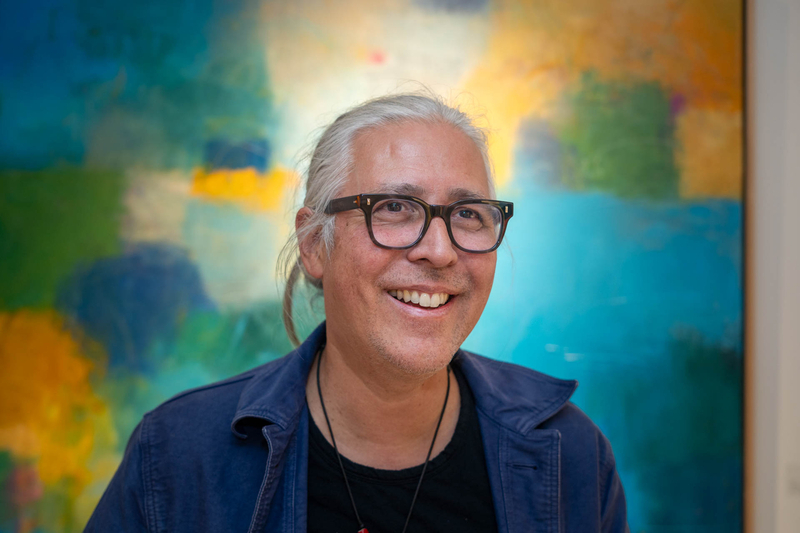
- Details
- By Kaili Berg
This recognition celebrates the accomplishments of both Asian and Indigenous people around the world and highlights Singletary’s important role in preserving and promoting Indigenous culture through his art.

Singletary’s career began in 1982 at the Glass Eye Studios in Seattle, Washington, where he was born and still lives today. He later trained at the Pilchuck Glass School, further developing his skills in glass art.
Over the years, Singletary has become known for blending traditional Tlingit designs with fine art. His sculptures are often inspired by Tlingit mythology, bringing these stories to life through his unique glass creations.
In addition to his focus on Tlingit culture, music also plays a key role in shaping Singletary’s artistic approach. He uses music to influence how he interprets Native stories in a modern context, creating a blend of tradition and contemporary art.
Singletary’s work is displayed in museums around the world, including in Boston, Seattle, Washington D.C., the United Kingdom, and Sweden.
Native News Online spoke with Singletary about his journey into glassblowing and the evolution of his artistic vision. He also highlights key projects, including his major exhibition Raven and the Box of Daylight and an upcoming set design for the Pacific Northwest Ballet.
Editor's Noete: This article has been edited for clarity and length.
Congratulations on your upcoming induction into the Asian Hall of Fame! How does it feel to have achieved this milestone?
It was quite a surprise, but I was really excited to receive the nomination. It came out of the blue since I wasn’t very familiar with the organization. It’s a nice dual recognition, honoring both my Filipino heritage and my Native heritage, which is really special.
Can you tell me a little about yourself and how you first got into glass blowing? What drew you to it?
It all started back in 1982. A friend of mine helped me get a job at a glass factory called Glass Eye Studios in Seattle, where I grew up. The studio was expanding quickly, and I landed an entry-level job working on simple things like paperweights and Christmas balls.
Over the next couple of years, I attended the Pilchuck Glass School, where I was exposed to international artists working with glass. What began as a day job turned into something I became passionate about. I kept learning and developing my skills, eventually finding ways to incorporate my Tlingit culture from Southeast Alaska, as well as my Filipino heritage.
Can you share how your Tlingit heritage influences your creative process?
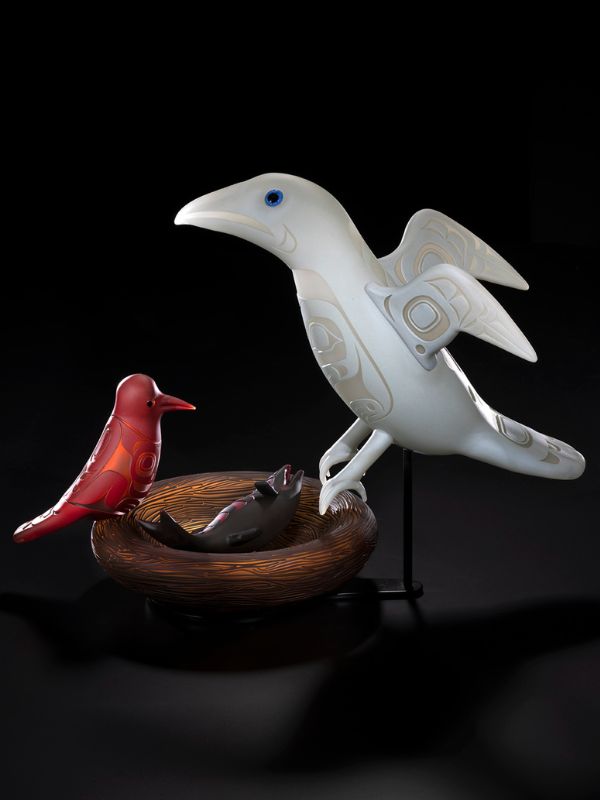
Around 1988, I began experimenting with incorporating traditional Tlingit design into glass through a sandblasting process. I would create a blown object, then carve traditional designs into it, transforming the pieces into sculptures.
Over time, this work took on a much deeper meaning for me as I realized I was one of the few Native Americans working with hot glass. The uniqueness of what I was doing gained attention, and I kept developing my skills. What really made my work stand out was the personal connection—it wasn’t just decorative, it was deeply tied to my cultural heritage.
 How has your artistic vision evolved since you first began creating glass sculptures?
It’s evolved a lot. In the beginning, I focused on creating objects that resembled traditional forms, like totem poles, bowls, and grease dishes. As my skills grew, I was able to create more complex and varied forms.
I also connected with elders like Walter Porter, a Tlingit storyteller. He gave me a deeper insight into the symbolism and mythology behind our stories, which greatly influenced my work. That connection led to the creation of a major exhibition called Raven and the Box of Daylight, based on Tlingit mythology.
It’s currently touring the country and has been extended to several museums. My connection with Tlingit culture deepened, and now I’m on the board of the Sealaska Heritage Institute, helping to preserve and teach traditional arts.
What message or feeling do you hope viewers take away when they experience your work?
I like to think that glass adds a new dimension to cultural arts. Traditional materials like cedar trees for totem poles are becoming rare, so glass offers a unique medium. It’s fragile yet durable and can last for thousands of years—or break in an instant. Its luminosity also adds a different allure. My goal is to preserve cultural symbols in glass, creating something new while still honoring tradition.
What are some upcoming projects or collaborations you’re excited about?
Right now, I’m working on a set design for the Pacific Northwest Ballet’s production of Sleeping Beauty, which opens in January. It’s not glasswork, but I’ve incorporated Tlingit designs into the set.
I’m also a musician, and my band, Khu.éex (which means “Potlatch” in Tlingit), just released our fifth album. We’ll be performing on Indigenous Peoples’ Day in Seattle in October. Beyond that, I’m involved in public art projects in both Seattle and Alaska.
What advice would you give to young Indigenous artists who want to get into the art world?
My advice is to be patient and persevere. Building your foundation as an artist takes time and effort. Network with other artists, stay engaged with the art community, and always look for opportunities. It takes a lot of work—10,000 hours, as they say—but it’s worth it. Be consistent, stay true to your vision, and never give up.
More Stories Like This
Vision Maker Media Honors MacDonald Siblings With 2025 Frank Blythe AwardFirst Tribally Owned Gallery in Tulsa Debuts ‘Mvskokvlke: Road of Strength’
Zuni Youth Enrichment Project and Partners at Ho’n A:wan Productions Launch 8th Annual Delapna:we Project
Chickasaw Holiday Art Market Returns to Sulphur on Dec. 6
Center for Native Futures Hosts Third Mound Summit on Contemporary Native Arts
Help us defend tribal sovereignty.
At Native News Online, our mission is rooted in telling the stories that strengthen sovereignty and uplift Indigenous voices — not just at year’s end, but every single day.
Because of your generosity last year, we were able to keep our reporters on the ground in tribal communities, at national gatherings and in the halls of Congress — covering the issues that matter most to Indian Country: sovereignty, culture, education, health and economic opportunity.
That support sustained us through a tough year in 2025. Now, as we look to the year ahead, we need your help right now to ensure warrior journalism remains strong — reporting that defends tribal sovereignty, amplifies Native truth, and holds power accountable.
 The stakes couldn't be higher. Your support keeps Native voices heard, Native stories told and Native sovereignty defended.
Stand with Warrior Journalism today.
Levi Rickert (Potawatomi), Editor & Publisher