This past year, the National Native American Boarding School Healing Coalition (NABS)interviewed more than 130 Indian boarding school survivors, expanded its digital archive, and released the second volume of a curriculum about the boarding school era. That’s according to the organization’s latest annual report, released today.
NABS launched in 2012 to spearhead a national strategy to increase public awareness and facilitate healing for survivors of the Federal Indian Boarding School Policy. The organization is behind a nation-wide effort to document the history, lived experiences of boarding school survivors and the ongoing impact of the Indian boarding schools.
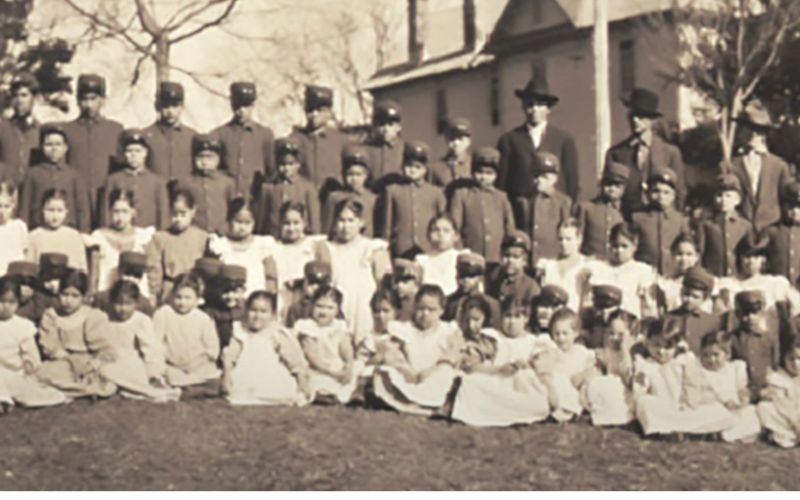
Stemming from the federal government’s campaign to “Kill the Indian, Save the Man,” the Indian Boarding School Policy resulted in American Indian and Alaska Native children being forcefully removed from their families and communities from the 1800s to as late as the 1970s to attend government and sometimes church-run schools. The institutions were tools of genocide, where children were forbidden to speak their language or practice their culture. Many Native children experienced physical and sexual abuse and neglect, sometimes resulting in death.
Expanded Archives, Healing
In 2025, in collaboration with the Department of the Interior, NABS interviewed 134 boarding school survivors, bringing the organization’s total to 263 for its oral history project.
As well, the organization took over the vast Indian Indigenous Digital Archive from the Museum of Indian Arts and Culture in New Mexico. The move expanded access to more than a century of historical records documenting federal and church-operated Indian boarding schools, Indian agencies, and Tribal land governance across the Southwest. As well, 2,000 additional Quaker-related boarding school records were scanned, totaling 24,317 digitized pages from Haverford and Swarthmore Colleges.
The Truth and Healing Commission on Indian Boarding School Policies Act has advanced with strong bipartisan support. NABS has garnered the endorsement of 52 Tribes and organizations, and has received support through 76 resolutions and petitions from organizations, including Tribes, churches, colleges, and cities. In April, NABS partnered with the Native American Rights Fund (NARF), the National Congress of American Indians (NCAI), and the Association on American Indian Affairs (AAIA) to educate the U.S. Supreme Court on Indian boarding school history and impacts.
NABS held 12 virtual healing circles led by Elder in Residence Sandy White Hawk and Native mental health professionals, and sent 216 care packages to elders affected by the boarding school system across Indian Country.
Education, Legislation
NABS released Volume 2 of the Truth and Healing Curriculum for high school students, aligned with academic standards in Minnesota, Michigan, Oregon, Washington, and New Mexico.
The Truth and Healing Commission on Indian Boarding School Policies Act has advanced with bipartisan support, endorsed by 52 tribes and organizations, with 76 resolutions from various institutions.
The organization reached a milestone in its advocacy for the Truth and Healing Commission on Indian Boarding School Policies Act. The act was unanimously passed by the Senate Committee on Indian Affairs on March 5, 2025. The act aims to:
Implement a 6-year mandate to formally investigate and document the full history of Indian Boarding Schools (526 identified schools) and their systematic impacts on Native American peoples.
Locate and identify marked and unmarked burial sites where boarding school students were interred, coordinate preservation of burial records, and share burial locations with affected families and tribes.
Allocate $90 million in funding and require minimum convenings in all 12 Bureau of Indian Affairs regions, plus Hawaii, to receive testimony from survivors and communities.
At Native News Online, our mission is rooted in telling the stories that strengthen sovereignty and uplift Indigenous voices — not just at year’s end, but every single day.
Because of your generosity last year, we were able to keep our reporters on the ground in tribal communities, at national gatherings and in the halls of Congress — covering the issues that matter most to Indian Country: sovereignty, culture, education, health and economic opportunity.
That support sustained us through a tough year in 2025. Now, as we look to the year ahead, we need your help right now to ensure warrior journalism remains strong — reporting that defends tribal sovereignty, amplifies Native truth, and holds power accountable.
The stakes couldn't be higher. Your support keeps Native voices heard, Native stories told and Native sovereignty defended.
Stand with Warrior Journalism today.
Levi Rickert (Potawatomi), Editor & Publisher
About The Author
Author: Elyse WildEmail:This email address is being protected from spambots. You need JavaScript enabled to view it.
Senior Health Editor
Elyse Wild is Senior Health Editor for Native News Online, where she leads coverage of health equity issues including mental health, environmental health, maternal mortality, and the overdose crisis in Indian Country. Her award-winning journalism has appeared in The Guardian, McClatchy newspapers, and NPR affiliates. In 2024, she received the inaugural Excellence in Recovery Journalism Award for her solutions-focused reporting on addiction and recovery in Native communities. She is currently working on a Pulitzer Center-funded series exploring cultural approaches to addiction treatment.



 The stakes couldn't be higher. Your support keeps Native voices heard, Native stories told and Native sovereignty defended.