- Details
- By Native News Online Staff
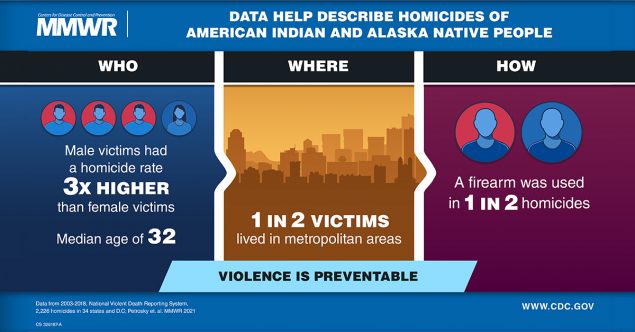
On November 19, 2021, the Centers for Disease Control released a report on homicides of American Indians/Alaska Natives from 2003-2018, as part of the National Violent Death Reporting System (NVDRS).
According to the report, homicide is a leading cause of death for American Indians/Alaska Natives (AI/ANs). For homicides related to intimate partner violence (IPV), nearly 90 percent of American Indian/Alaska Native female victims were killed by a current or former intimate partner.
Want more Native News? Get the free daily newsletter today.
The report covers data on 2,226 American Indian/Alaska Native homicides collected from 34 states (Alabama, Alaska, Arizona, California, Colorado, Georgia, Illinois, Indiana, Iowa, Kansas, Kentucky, Louisiana, Maine, Maryland, Massachusetts, Michigan, Minnesota, Missouri, Nebraska, Nevada, New Jersey, New Mexico, New York, North Carolina, Ohio, Oklahoma, Oregon, Pennsylvania, Rhode Island, South Carolina, Utah, Virginia, Washington, and Wisconsin) and the District of Columbia.
The homicide rate was 8 per 100,000 AI/AN population, and the rate was three times higher in men than women. The median age of victims was 32 years old, and the average age range was 23–44 years old.
About half of the homicide victims lived in or were killed in metropolitan areas, and a firearm was used almost half of the homicides. Firearms were also used to kill more men more often than women.
Over 80 percent of the suspects were male, but less than a third of the suspects were AI/ANs. Over 50 percent of suspects were white, non-Hispanic.
Women were more likely to be killed in their own home.
Women were more likely to be killed by a current or former intimate partner, while men were more likely to be killed by a friend or relative.
The report shows interpersonal conflict was a predominant circumstance leading to the homicide, with nearly half of all homicides preceded by an argument.
Data from the report includes victim and suspect sex, age group, and race/ethnicity; method of injury; type of location where the homicide occurred; events that contributed to the homicide; and other selected characteristics. Read the report here.
More Stories Like This
Native News Weekly (August 25, 2024): D.C. BriefsUS Presidents in Their Own Words Concerning American Indians
Native News Weekly (December 14, 2025): D.C. Briefs
Wounded Knee Massacre Site Protection Bill Passes Congress
Two Murdered on Colville Indian Reservation
Help us defend tribal sovereignty.
At Native News Online, our mission is rooted in telling the stories that strengthen sovereignty and uplift Indigenous voices — not just at year’s end, but every single day.
Because of your generosity last year, we were able to keep our reporters on the ground in tribal communities, at national gatherings and in the halls of Congress — covering the issues that matter most to Indian Country: sovereignty, culture, education, health and economic opportunity.
That support sustained us through a tough year in 2025. Now, as we look to the year ahead, we need your help right now to ensure warrior journalism remains strong — reporting that defends tribal sovereignty, amplifies Native truth, and holds power accountable.
 The stakes couldn't be higher. Your support keeps Native voices heard, Native stories told and Native sovereignty defended.
Stand with Warrior Journalism today.
Levi Rickert (Potawatomi), Editor & Publisher